
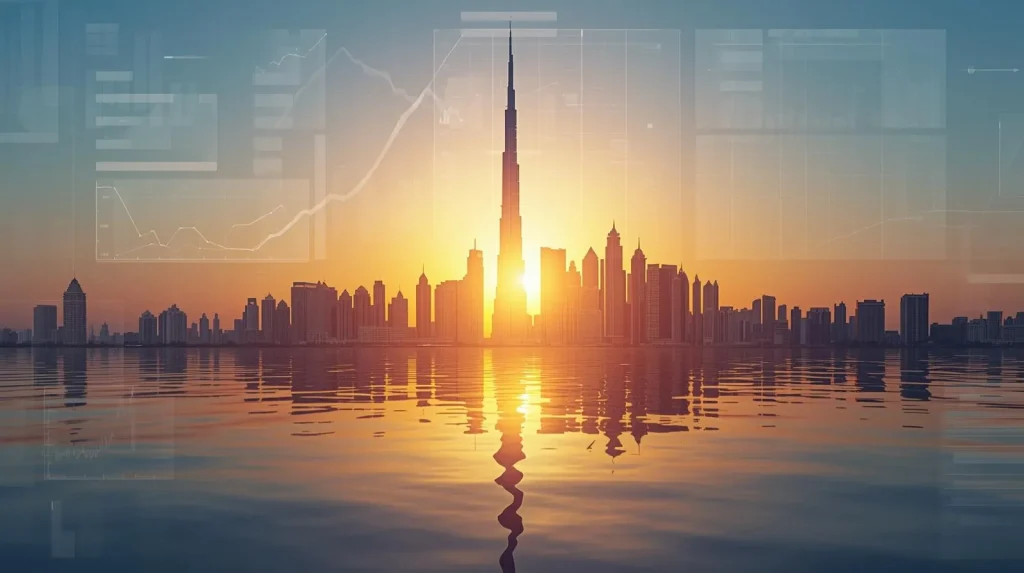
Dubai’s economic resilience in a time of global economic turbulence. At a time when international organisations have painted a subdued outlook for global economic growth, the economy of the UAE and, in particular, Dubai has shown that it has greater resilience than other countries. Concerns such as global inflation, wars and geopolitical tensions, and the possibility of downturn in major economies such as the US and Europe have occupied investors’ minds. Global trade in goods is forecast to grow only very modestly this year (around 1.7%), and some do not rule out economic downturn in the United States and Europe. Nevertheless, in this ambiguous environment, Dubai has been able to demonstrate remarkable resilience by relying on its strong structures.
Current concerns in the global economy and Dubai’s position
The global economy is grappling with numerous challenges. Inflation in many countries has reached the highest levels seen in decades over recent years, forcing central banks to raise interest rates sharply. These policies have, on the one hand, been necessary to curb inflation, but on the other hand they have slowed global economic growth and increased the risk of downturn in some regions. Geopolitical tensions (such as wars) have also disrupted supply chains and pushed up energy prices, making it harder for businesses to continue operating. For example, the Organisation for Economic Co-operation and Development has warned that growth in many developed economies will decline. Even so, the UAE and Dubai have performed better than their global peers; for instance, in 2024 the UAE economy grew by about 3.9% while the average growth of the world economy was only 3.3%. These figures show that Dubai and the UAE have been less vulnerable to global shocks and have maintained their development path.
Why is Dubai’s economy more resilient today than before?
- In recent years, Dubai has strengthened its economic foundations through structural reforms and targeted investments, and has become more resilient to past crises. Below, we point to some of the most important factors strengthening Dubai’s economic resilience:
- Economic diversification and reduced dependence on oil: Following the 2008 financial crisis, policymakers in the UAE deliberately moved towards economic diversification. The result of these efforts is that the non-oil sector now accounts for around three-quarters of the country’s gross domestic product. With the growth of sectors such as tourism, trade, transport, financial services and property, Dubai has sharply reduced its dependence on oil revenues. The UAE has also diversified its trade partners and reduced reliance on a limited number of countries. This economic diversification means that if oil prices fall or one sector slows down, other sectors can make up the gap and prevent a sharp decline in the economy.
- Smart financial policies and structural reforms: Over the past decade, the UAE government has implemented cautious fiscal policies and deep economic reforms that have improved economic stability. For example, a new bankruptcy law was introduced in 2016 to manage business failures in a structured way and prevent problems from spreading across the system. In the property sector, regulations were approved to protect buyers’ rights and curb speculation, in order to prevent the formation of risky bubbles. In addition, to strengthen government finances and reduce reliance on oil, Value Added Tax (VAT) was introduced in 2018 and corporate income tax in 2023. The resulting revenues are used to develop infrastructure and major projects, which in turn support sustainable economic growth. The UAE has also created huge sovereign wealth funds that store resources during boom periods and support the economy during crises. Taken together, these measures have strengthened the government’s financial base and enabled counter-cyclical policymaking (injecting resources during downturns).
- Strategic position and attraction of international capital: Owing to its outstanding geographical position (linking Europe, Asia and Africa) and advanced port and airport infrastructure, Dubai has become a global trade hub. Even in conditions where global trade has slowed, Dubai generates significant income from the transit of goods and services. Beyond trade, Dubai is one of the region’s leading investment destinations. Foreign investors, drawn by political stability, business-friendly laws, tax exemptions and free zones, have channelled substantial capital into the UAE. According to reports, 2024 saw a new record in foreign direct investment (FDI) inflows into the UAE, and strong domestic consumption and investment will remain the engine of growth in 2025. The attraction of investors and wealthy individuals to Dubai also continues; for example, the UAE retained first place globally for attracting wealthy migrants for the third consecutive year, and by the end of 2024 around 6,700 new millionaires had taken up residence in the country. The presence of this human and financial capital, in addition to energising markets, has created a network of entrepreneurs and investors in Dubai that helps generate new businesses and jobs.
- Tourism growth and a knowledge-based economy: Through continuous investment in the tourism industry and hosting major international events (from Expo 2020 to global conferences in technology and the green economy), Dubai has been able to consolidate its position as a safe tourism and business destination. After emerging from the difficult period of the pandemic, Dubai’s tourism sector made a striking comeback and attracted nearly 17.15 million foreign tourists in 2023. This trend continued in 2024, with tourist numbers rising by 9% year on year to 18.72 million, a new record for the city. In the first two months of 2024 alone, Dubai hosted more than 3.6 million tourists. This indicates strong global demand to visit the city. Tourism revenues account for a significant share of the non-oil economy and have boosted sectors such as hospitality, retail and transport. On the other hand, by launching initiatives such as the AI Strategy 2030, technology parks and the attraction of innovative companies, Dubai is in the process of becoming a hub for technology and a knowledge-based economy. This approach has further diversified Dubai’s economy and will sustain the pace of growth in the future.
- Financial stability and a stable business environment: Inflation in the UAE has been brought under control and has been on a downward trend since mid-2023, so that the annual inflation rate in October 2024 reached about 2.4%, the lowest level in more than a year. Low inflation means stable purchasing power and more predictable costs for businesses. The value of the UAE dirham against the US dollar is also fixed and stable, which protects the economy during periods of global currency turbulence. The UAE banking system, under the close supervision of the Central Bank, is in good health and banks’ capital adequacy ratios are high. The government is prepared to support banks if necessary (as it did during the 2008 crisis). Dubai’s business environment is also highly competitive and open. The UAE rose to 7th place in the 2024 global competitiveness report, overtaking countries such as Japan and Canada. Indicators such as government efficiency, ease of starting a business, digital infrastructure and investment security are all at a high level in this country. All these factors have meant that Dubai is seen as a safe haven for investors even during periods of global uncertainty, and business actors’ confidence in its future remains intact.
Dubai’s Real Estate Market Expansion in 2025 (Residential and Office)
One of the most striking signs of Dubai’s economic resilience is the unprecedented expansion of its real estate market amid global turbulence. Dubai’s real estate sector, once a weak point of the economy during earlier crises, has now become one of the main pillars of growth thanks to reforms and strong demand. In recent years, domestic and foreign capital have flowed enthusiastically into Dubai’s residential and office markets, setting new records. Below is a look at the latest position of this sector in 2025:
Housing Sector (Residential Real Estate):
Dubai’s housing market has experienced its golden period over the past two years. In 2024 alone, more than 170,000 housing transactions were registered in Dubai, with a total value of over USD 100 billion. Annual housing transaction volume in Dubai rose by 36% compared with the previous year and reached a new historic record. The influx of wealthy buyers from around the world – from Indian and Saudi investors to Europeans – has played an important role in this boom. According to an international report, in 2024 Dubai recorded the highest number of ultra-luxury home sales transactions (above USD 10 million) in the world for the second consecutive year (435 transactions, roughly equal to London and New York combined). This is evidence of Dubai’s growing appeal to the world’s wealthy as a place to live and invest. Strong genuine demand has also driven prices up significantly; the average sale price of residential real estate in Dubai rose by around 19.1% in 2024 to about AED 1,685 per square foot, which is 13.3% above the market’s previous peak in 2014. In particular, villa prices over the 12 months to the end of Q1 2025 increased by nearly 19.6% and now stand at about AED 2,088 per square foot; this figure is more than double the prices at the start of 2020. Importantly, unlike in previous periods, the majority of current buyers are end users (buyers for occupancy) rather than short-term speculators. This change in market structure – which was accompanied by evidence such as a 48% decline in the number of ready units for sale in the ultra-luxury segment (above AED 50 million) during 2024 – shows that Dubai’s property market has become more mature and stable than before and is less exposed to artificial bubbles.
Office and Commercial Sector (Offices and Office Spaces):
Dubai’s office real estate market has also grown spectacularly alongside the residential sector and is in an unprecedented position, even contrary to the global trend. While office demand has fallen in many major cities around the world after the coronavirus pandemic, Dubai has seen a significant increase in demand from domestic and international companies for office space. During 2024, around 1.28 million square feet of new office space demand was recorded in Dubai, which is 64% higher than in 2023. Many international companies, especially in financial services, technology and trade, have moved their regional offices to Dubai or are expanding them there. The result of this demand has been the filling of office capacity in the city’s key commercial districts; in Dubai International Financial Centre (DIFC), Downtown and Business Bay, office occupancy rates have reached around 95% to 99%. A shortage of prime office supply has caused rents to surge; for example, average office rents in Business Bay rose by about 46% over the past year. Even in areas such as Sheikh Zayed Road and new projects around Expo, high demand from companies has been observed. A senior commercial real estate expert in Dubai has emphasised that the story of Dubai’s office market is completely different from the global trend; any new office space supply is immediately reserved by demand, and despite recent rent growth, rates in some areas are still below the 2008 peak. In order to respond to this market appetite, around 8.2 million square feet of new office space will enter the market between 2025 and 2028, almost twice the supply of the past four years. Overall, the real estate market boom, whether residential or office, not only reflects the confidence of investors and companies in Dubai’s future, but also acts as a driving force for economic growth (through job creation in construction, real estate services, financial transactions and so on).
Conclusion: Dubai, a Safe Harbour in the Turbulent Sea of the Global Economy
Based on what has been reviewed, it can be said that today Dubai’s economy has entered the future more resilient and more diversified than at any other time. Economic reforms, smart management, diversification and investment in growth-driving sectors have enabled Dubai to remain agile and stable in the face of external crises. Analysts even believe that although the global turbulence of 2025 may be more difficult than the 2008 crisis, the UAE and Dubai are now in a much stronger position to deal with shocks. International investor confidence in Dubai remains high, and this can be seen in the unprecedented inflow of capital, the migration of wealthy talent and the recording of new economic records. By maintaining internal economic stability (low inflation, a stable currency, a strong banking system) and adopting a forward-looking approach (investment in new technologies, clean energy and sustainable development), Dubai is turning global challenges into opportunities for its own growth.
For smart investors, Dubai appears like a safe island in the turbulent sea of the global economy. This city is considered one of the best investment options not only because of favourable business regulations and attractive investment returns, but also because of its clear development outlook in the years ahead. The UAE economy is expected to continue its strong growth in 2025, with Gross domestic product growth rates, according to various sources, ranging between 4% and 6%, which is far above the average forecast for advanced economies. In addition, Dubai’s non-oil sectors, from trade and tourism to real estate and technology, will be the main engine of this growth.
In closing, I emphasise that Dubai’s economic resilience is neither accidental nor temporary; rather, it is the result of years of foresight and measured action that is now bearing fruit. Dubai has learned from every crisis and has transformed itself into a more flexible, more attractive and stronger city. Despite all global uncertainty, Dubai’s outlook appears bright, and the city remains ready to welcome new opportunities and investors with open arms – an opportunity that should not remain hidden from the eyes of any forward-looking investor.
Author: Hamed Ghelichkhani
