
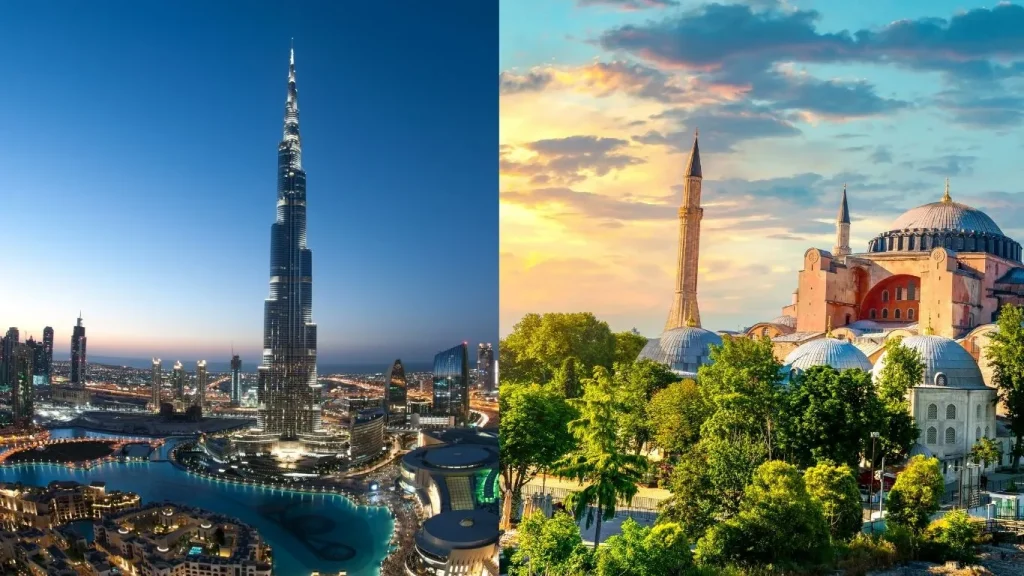
“Is buying property in Dubai better than Turkey?” This is a question that has occupied the minds of many Iranian investors. Based on studies carried out recently, it has been found that the total share of property sales to foreigners in Turkey in 2024-2025 has declined, and Iranians were the second-largest group of buyers. Dubai, with unique advantages such as tax exemption, a 10-year Golden Visa and …, is a better choice for Iranians, and this can make a significant difference in the future. In this article from Hamed Ghelichkhani‘s website, we compare Dubai and Turkey for buying property.
Why buying property in Dubai is a smarter choice than Turkey:
- Higher investment returns (an average of around 6–8% in Dubai; in Turkey, this figure varies from 5 to 8 per cent depending on the location and property type)
- Economic and political stability without severe currency fluctuations
- Exemption from income tax and rental tax
- A simple and fast residency process (2-4 weeks for the Golden Visa)
- World-class infrastructure and outstanding quality of life
- High social security and an excellent environment for families
- A variety of luxury projects with flexible payment plans in Dubai
Unlike Turkey, which is facing 33.4% inflation in 2026, Dubai has greater economic stability, which is considered a key factor in preserving the value of property investments. In the following sections, we will look more closely at a full comparison of investment in Dubai and Turkey; stay with us.

Comparison of buying property in Turkey and Dubai
| Criterion | Dubai | Turkey |
| Minimum investment for residency: | 204,600 dollars average price per square metre in the city centre: 3,270 to 9,540 dollars | 204,000 dollars average price per square metre in the city centre: 3,270 to 9,540 dollars |
| Property type: | One-bedroom apartment (city centre) around 653,506 to 707,965 dollars, one-bedroom apartment in Business Bay from 326,753 to 517,359 dollars | Apartment from 27,000 dollars, villa from 300,000 dollars |
| Rental income: | None | 15 to 35 per cent |
| Average annual rental yield | around 6–8% | depending on the area, around 5–8% |
| Market liquidity | High (strong demand for rentals) | Medium (location-dependent) |
| Price stability | High (less affected by inflation) | Greater volatility (annual inflation in July 2025 ≈ 33.5%) |
| Residency processing time | 2 to 4 weeks | 1–3 months (property citizenship: 8 –12 months) |
| Residency validity | 5 or 10 years (renewable, with spouse and children under 18) | One year (renewable, accompanied by family under special conditions) |
Comparison of Turkey and Dubai in housing prices
Dubai offers more amenities and there is greater scope for progress in different parts of the city; for this reason, housing prices in Dubai may be higher. However, this price difference is accompanied by benefits such as tax exemption and higher rental yields. If you intend to buy property in Dubai, it is better to know that you are not just buying property, but also a luxury lifestyle and first-class infrastructure. Taking these points into account, the choice between Dubai and Turkey depends entirely on individual objectives. Below, we answer the two questions: is living in Dubai better than Turkey? and is buying property in Dubai better than Turkey?
Dubai is one of the world’s luxury destinations and, because of its advanced amenities, it has always been among the popular choices for many different people.
| Criterion | Dubai | Turkey (Istanbul) |
| Minimum investment for residency | 750,000 dirhams (equivalent to 204,000 dollars) | 400,000 dollars |
| Price per square metre of apartment in Downtown Dubai | Average ≈ 2,850 to 3,170 dirhams/ footIn total: from 30,800 to 34,100 dirhams | 1,271 dollars |
| Buying a one-bedroom apartment in Downtown Dubai | 2.4 to 2.6 million dirhams | 150 to 250 thousand dollars (depending on neighbourhood/building age). Based on Endeksa’s average of ≈1,271 dollars/m², a 75m² unit comes to ≈95 thousand dollars; however, in prime areas it can also reach 2–3 thousand dollars/m² and above |
| Buying a 3-bedroom villa in Dubai Hills Estate (Dubai Hills Estate) | Average listing ≈ 8.1M AED; transactions 4.9–9M | 600 thousand to 2 million dollars+ (very wide range; depending on area/building age/land) |
Comparison of Dubai and Turkey in rental yield and return on investment
Rental yield and return on investment are among the most important criteria for investment; for Dubai residency or residency in Turkey, which are known as the most popular destinations for Iranians, paying attention to rental yield and return on investment is extremely important:
Rental yield
Rental yield in Dubai is on average 6 to 8 per cent, and this figure has made it one of the highest rental yields in the world. Dubai has a large commercial and tourism hub and has always hosted a large number of migrants, foreign workers and tourists.
By contrast, rental yield in Turkey, especially in the city of Istanbul, varies at around 5–8% depending on the area. Of course, areas such as Beşiktaş and Nişantaşı in Istanbul or Antalya offer good rental yields, but in general, Dubai has competitive and attractive returns (often 6–8% and higher in some submarkets), although according to 2025 comparison tables, other cities also have similar/higher returns; for example, Istanbul at ≈8.15% and several regional markets in the Middle East/Africa.
Dubai’s advantage in rental yield:
- A thriving rental market due to migrants and foreign workers
- Higher rental yield (H1-2025 reports from Bayut/Dbzle show that rents have risen or stabilised in many neighbourhoods)
- Continued demand in well-known areas such as Downtown, Dubai Marina and Palm Jumeirah
Return on investment
Thanks to property growth and higher rental yields in Dubai, return on investment in this area is higher, and investors can recover their initial capital over 10 to 15 years through rental income and property value growth. In addition, annual property price growth in Dubai is between 5 and 7 per cent, which indicates market stability and investment appeal. In Turkey, however, this figure is somewhat slower, and it usually takes 15 to 20 years for the initial capital to be recovered through rent and property price growth. Annual property price growth in Turkey is also between 3 and 5 per cent, which is lower than Dubai’s growth in comparison.
Reasons for faster return on investment in Dubai:
- Annual property price growth of 5 to 7 per cent
- Return on investment over 10 to 15 years (versus 15 to 20 years in Turkey)
- Economic stability and low inflation (~2 %)
Income tax on rent and investment laws
Investors in Dubai are fully exempt from tax on rental income and property sales; in other words, all income from rent is received net by the property owner. Income tax on rent in Turkey varies between 15 to 35 per cent. This difference in tax laws is considered one of the main reasons for choosing Dubai as an investment destination.
Dubai’s tax advantages compared with Turkey:
- Full tax exemption on rental and property sale income
- Simpler rules for foreign investors
- Fixed, specified title deed transfer cost (4% in Dubai)
Alongside the tax differences, the ownership structure for foreign investors is also one of the key criteria for comparing these two markets. In Dubai, the official UAE government portal explicitly confirms foreign nationals’ ownership rights in designated freehold areas, and title deeds for these properties are also issued through Dubai Land Department:
“In Dubai, foreign ownership is permitted in areas designated as freehold. The title deeds are issued by the Land Department in the emirate.”
“In Dubai, foreign ownership is permitted in areas designated as freehold. The title deeds are issued by the Land Department in the emirate.”
There is greater economic stability in Dubai and low inflation (~2%), which has led to strong demand for buying and renting property in popular areas such as Downtown Dubai and Marina. This is while Turkey has high economic volatility and inflation of around 33.5%, which has had a negative impact on the property market. Buying property in Dubai is a better option and there is greater potential for progress.

Comparing the property market in Dubai and Turkey
The property markets in Dubai and Turkey differ because of economic differences and varying rental yield rates. The price per square metre in Dubai city centre is around USD 9,280 per square metre. This level is a more suitable benchmark for Dubai’s “luxury centre”; AED 12,000 per square metre is much lower than Downtown. Prime districts are higher at USD 1,271/m² (July 2025).
The rental yield in Dubai is, on average, up to 8%, and luxury areas such as Downtown, Dubai Marina and Palm Jumeirah enjoy the highest demand. The rental yield in Turkey is between 5 and 8%. Renting a one-bedroom apartment in Downtown Dubai city centre is around USD 3,240 per month, while in central Turkey this figure is around USD 800 to 1,300 per month. “USD 500–800” has been reported for lower-end areas.
The Dubai property market is more stable; for more information about the Golden Visa of the UAE, contact us via the WhatsApp link.
Comparing Dubai and Turkey for investment
Investing in Dubai is a more suitable option because of the high rental yield, a quick return on investment over 10 to 15 years, and annual property price growth of 5 to 7%. In addition, the full tax exemption on rental and property sale income has made this city a good destination for investment. By contrast, investing in Turkey is suitable for people with a limited budget, and we recommend choosing Dubai for investment. You have probably already reached good reasons for residency in Turkey or Dubai by now; next, we look at the cost of maintaining property in Dubai and Turkey.
The cost of maintaining property in Dubai and Turkey
To better understand the differences in property maintenance costs in Dubai and Turkey, it is better to pay attention to the points below:
Tax and insurance
In Dubai, there is no annual tax on property ownership, but property and asset insurance is essential to protect the home against natural and unexpected events. Property tax in Dubai is 5%, which, based on annual rent (monthly on DEWA (Dubai Electricity and Water Authority)), applies to residents or owners who live in the property themselves (example: AED 200,000 coverage equals AED 1,000/year). Villa structure insurance is usually 0.1–0.5% of rebuilding value (for a AED 2.5 million villa, equivalent to AED 2,500/year). A realistic consumption range for standard homes is AED 500 to 2,000/year (higher for luxury homes).
Annual property tax (Emlak Vergisi) in Turkey for residential use is around 0.1–0.2% of cadastral value (double the minimum in metropolitan areas). 0.6% relates to land or other uses, not apartments. Earthquake insurance (DASK) in Turkey is mandatory and covers losses arising from earthquakes and related incidents, equivalent to: example insurance premium for a 100-square-metre unit, depending on risk/structure type, around ≈ TRY 1,700 to 2,700.
Municipal service costs (water, electricity, gas and internet)
In Dubai, annual utility bills for electricity and water (DEWA): between AED 250–500 per month (average; higher in summer). Home internet plans from providers are AED 199–299 per month. District Cooling (in many neighbourhoods): fixed capacity charge ≈ AED 750 per RT per year + consumption costs. Overall in Dubai, bills + internet are ≈ AED 5,400 to 9,600 (excluding District Cooling).
In Turkey (for an apartment of 70–90 square metres), utility bills are estimated at around TRY 500–1,000 per month (depending on city/season) and internet at around TRY 150–300 per month.
Repair and maintenance costs
Property maintenance includes emergency services, plumbing, air-conditioning servicing and regular inspections; these costs include:
Building service charge (Owners Association/Service Charge):
- Apartments: ≈ AED 10–30/square foot/year (depending on facilities/location; higher for luxury). For a one-bedroom apartment of 800 square feet, this equals AED 8,000 to 24,000/year.
- Villa in Dubai Hills: AED 3–4/square foot/year; in very luxury projects (for example Palm), ≈ 15–25 is also seen.
- Maintenance contracts (AC/plumbing/emergency): annual packages for villa/townhouse of ≈ AED 3,000–6,000 are common.
These figures in Turkey are as follows: Aidat (community charge): depending on facilities ≈ USD 20 to 100/month or ≈ TRY 200–1,500/month (higher for luxury properties).
Pool and garden maintenance
Pool and garden maintenance costs in Dubai and Turkey differ on an annual basis:
In Dubai:
- Private pool: usually ≈ AED 4,000–6,000/year (≈ AED 350–500/month).
- Garden/landscape: depending on size/number of visits ≈ AED 3,000–8,000/year (≈ AED 250–1,000/month).
In Turkey, this depends on the community/villa facilities and is usually included in Aidat (building charge) or separate contracts.
Comparing Dubai and Turkey in residency
Dubai, one of the best cities in the UAE, offers work, investment and study visas with transparent and fast procedures, whereas buying property in Turkey involves longer processes. Thanks to family sponsorship, the UAE Golden Visa and more, residency in Dubai has become one of the best decisions for people who constantly ask themselves: Is living in Dubai better or Turkey! With tax exemption, advanced infrastructure and other advantages, Dubai offers more job opportunities than Turkey. Laws in the UAE are also stricter and there is greater security.
In Turkey too, owning property can be the basis for applying for short-term residency, but simply owning any kind of property at any value is not enough for this route. In official documents published on the Presidency of Migration Management of the Ministry of Interior of Turkey, for applicants applying for residency on the basis of property ownership, the minimum value of a residential property is explicitly stated as at least the equivalent of USD 200,000 in Turkish lira:
The UAE Golden Visa starts from AED 2 million for buying property, and a work visa costs between AED 3,000 to 10,000. By contrast, student visa costs are estimated at around AED 3,000 plus university tuition.
For short-term residency based on property ownership, you need an initial budget of at least USD 200,000; the “residency document fee” was announced as 565 lira in 2024 (the 2025 update is carried out based on the annual circular), and residency charges vary depending on nationality; in addition, insurance and translation/notarisation are added. Some cities have limited extensions for general tourism.
A work permit in Turkey is subject to a “permit fee” and a “securities fee”, which are announced each year by the Ministry of Labour and range from a few thousand to tens of thousands of lira (different amounts apply for fixed-term/indefinite permits). A 2025 range example: for temporary permits, amounts of several tens of thousands of lira plus a separate card fee have been announced.
To renew residency in Dubai, maintaining the initial conditions such as employment or investment is mandatory, and its cost changes annually:
- 2-year property owner visa (renewable);
- 10-year Golden Visa (renewed every 10 years).
- Renewal costs include residency charges, ID, medical and other fees, which are itemised in GDRFA service cards (General Directorate of Residency Affairs, Dubai)

For residency in Turkey, you can apply through the following methods:
- Long-term residency (indefinite) can be applied for after 8 years of continuous residency (subject to additional conditions).
- “Ordinary citizenship” can be applied for after 5 years of continuous residency (subject to conditions), which is not the same as “permanent residency”. These processes have their own costs.
Comparison table of residency conditions in Dubai and Turkey
| Criterion | Dubai | Turkey |
| Time to obtain residency | A few weeks (case-dependent; no official guaranteed time has been announced). For the property/Golden route, it is generally completed within a few weeks after the title deed is issued and documents are completed. | Up to 90 days from the date of “document completion” under the law; in practice usually ≈ 1–3 months |
| Residency validity | Depending on the route: 2 years (property owner), 5 years (green), 10 years (golden). Family inclusion is possible: spouse and children (sons up to 25 years old, unmarried daughters with no age limit). | 1 year (short-term property residency) renewable; “long-term/indefinite residency” after 8 years of continuous residency. Family inclusion is through family residency (spouse and children under 18) and subject to the sponsor’s conditions. |
An important difference between these two routes can also be seen in the legal outcome of the investment. In Dubai, buying a property that meets the specified conditions can lead to Golden Residence; whereas Turkey also provides for a citizenship application route for higher-value property investment. GDRFA Dubai and Investment Office of the Presidency of Türkiye define these two routes as follows:
Dubai – GDRFA:
“Ownership of one or more properties with a value of no less than AED 2,000,000.”“Ownership of one or more properties with a value of at least AED 2 million.”
Türkiye – Investment Office:
“Shall purchase real estate worth at least USD 400,000 … shall not sell the real estate for three years.”“The applicant must purchase property worth at least USD 400,000 and must not sell the property for three years.”
Comparison of living costs in Dubai and Turkey
The cost of living in Dubai is higher than in Turkey because of the higher quality of life and better amenities. Below, we have listed living costs in Dubai and Turkey so you can become more familiar with these two popular regions for Iranians:
Cost of living in Dubai
- Rent for a one-bedroom apartment (city centre or Downtown Dubai) is AED 143,000 (≈ AED 11.9k/month) / rent for a one-bedroom in Business Bay is AED 95,000–116,000/year (≈ AED 8–9.7k/month).
- Rent for a 3-bedroom apartment (city centre): AED 404,000 (≈ AED 33,000/month) / rent for a three-bedroom in Business Bay is AED 215,000/year (≈ AED 18k/month).
- Food (family of 4): AED 3,500–7,000 (equivalent to USD 950–1,900)
- Transport: AED 500–1,000 (equivalent to USD 140–270)
- Internet and bills: AED 500–1,200 (equivalent to USD 140–330)
- Health insurance: AED 500–1,500 (equivalent to USD 140–410)
- Education (international schools – annually): AED 30,000–100,000 (equivalent to USD 8,200–27,300)
Cost of living in Turkey (Istanbul)
- Rent for a 1-bedroom apartment (city centre): USD 900–1,200/month
- Rent for a 3-bedroom apartment (city centre): USD 1,600–2,100/month
- Food (family of 4): USD 300–600
- Transport: USD 40–60
- Internet and bills: USD 50–70
- Health insurance: USD 100–200
- Education (international schools – annually): USD 5,000–10,000
Comparison table of living costs in Dubai and Turkey
| Criterion | Dubai | Turkey |
| One-bedroom apartment rent | AED 7,750 to 10,000 | USD 900–1,200/month |
| Food for a family of 4 | AED 3,500 to 7,000 (USD 950 to 1,900) | USD 300 to 600 |
| Transport | AED 500 to 1,000 (USD 140 to 270) | USD 50 to 100 |
| Internet and bills | AED 500 to 1,200 (USD 140 to 330) | USD 50 to 100 |
| Health insurance | AED 500 to 1,500 (USD 140 to 410) | USD 100 to 200 (private) |
| Education cost (international, annually) | AED 30,000 to 100,000 (USD 8,200 to 27,300) | USD 5,000 to 20,000 |
If you prefer to live somewhere with lower living costs, choose Turkey; but if you are looking for progress, a high-quality life and excellent amenities, residency in Dubai is the better option. To get more information about the UAE Golden Visa, contact our consultants so they can help you on this path.
Living conditions in Dubai
The United Arab Emirates, with its high living standards and modern infrastructure, is one of the most popular countries for work, life and migration. More than 200 different nationalities from around the world, with diverse religions and languages, live here. High security and low crime are among the benefits associated with residency in Dubai.
International schools with educational standards (IB, British and American) for residents and expatriates, reputable universities such as the University of the Emirates and the University of Sharjah, and the implementation of the “Education Strategy 2021” programme to improve the quality of the education system are among the favourable educational conditions in Dubai.
Modern hospitals such as “NYU Abu Dhabi” and the American Hospital, and mandatory health insurance for residents and expatriates, are among the measures implemented in the country’s healthcare system.
The best areas for residency in Dubai
| Area | Key features | Price level | Suitable for |
| Dubai Marina | Luxury waterfront, shopping centres and modern entertainment | High | Professionals, young couples, short-term letting investors |
| Palm Jumeirah | Exclusive villas, calm and family-friendly atmosphere | Luxury | Affluent families |
| Dubai Hills | Villa / townhouse and low-rise apartment | High | Families, middle/senior managers |
| Deira | Old fabric, Gold Souq and spice market, extensive metro/bus network | Mid to high | Young/middle-aged families |
| Al Barsha | A blend of tradition and modernity, easy access | Mid to high | Young families |
| Mirdif | Residential and quiet, excellent educational amenities | Medium | Families with children |
| Jebel Ali | Close to industrial areas and the port | Affordable | Industrial and labour workers |
Living conditions in Turkey
Housing rent, food and transport are cheaper in Turkey, and residency and property purchase in Turkey cost USD 400,000. Turkey has a high-quality and cost-effective healthcare system, the cost of medical services is also much lower than in other countries, and health insurance is also available for expatriates.
With suitable living costs, pleasant weather and diverse amenities, Turkey is an attractive option for expatriates. A work permit requires an employer sponsor; some professions have restrictions, and knowing Turkish is practically key for the labour market.
The best cities for living in Turkey
| City | Features | Suitable for | Cost of living (approx.) |
| Istanbul | Financial-cultural capital, large job market, excellent accessibility (metro/metrobüs/airport), prime neighbourhoods (Beşiktaş/Şişli/Kadıköy) | Professionals, entrepreneurs, postgraduate students | High |
| Antalya | Coastal tourism hub, international flights, strong tourism services, Konyaaltı/Lara beaches | Retirees, families seeking beachfront living | Medium to high |
| Izmir | Family-friendly, a city with a beautiful coast and a more western culture | Families, students | Medium |
| Bodrum | Luxury coastal city with excellent leisure facilities | Second-home owners, luxury/artistic lifestyle, seasonal rental investors | High to very high |
| Alanya | More affordable city, with a large migrant and tourist population | Migrants on a limited budget | Affordable to medium |
The cost label is based on housing costs + daily living expenses in the central areas of each city and changes with the season/neighbourhood.
Advantages of buying property in Dubai
Buying property in Dubai is a reliable way to obtain Dubai residency; because, with the UAE’s various Golden Visa programmes for investors and property buyers, it brings long-term residency. But is living in Dubai better or Turkey? Dubai is a better choice thanks to its advanced infrastructure, high security and dynamic job market, and Dubai’s real estate market is more modern in terms of variety and build quality, making it a more attractive option for investors.
Because there is no property or income tax in Dubai, it provides better financial conditions for owners, whereas this is not the case in Turkey. The option to let property in Dubai, with high income and an active rental market, has made property investment possible. Economic inflation in the UAE is low so that more opportunities are available for investors.
Ultimately, if you want to choose between residency in Turkey or Dubai, Dubai is regarded as the more popular option because of its suitable working environment, security and luxury lifestyle.
Learn more: Advantages and disadvantages of buying property in Dubai
So, should we buy a house in Dubai or Turkey?
Buying property in Dubai or Turkey has always been one of the most popular topics for Iranian investors, and given Dubai’s clear and significant advantages, this region is recognised as the first choice for many people in 2026. Although the cost of living in Turkey is lower than in Dubai, with Dubai residency you can benefit from advanced facilities and a better living environment.
With features such as tax exemption, return on investment, a low inflation rate and social security, Dubai is seen as a more attractive option for residency and investment and brings a secure future. Ultimately, choosing between buying property in Dubai or Turkey depends on your personal goals, budget and living conditions.
For more information about Dubai residency or the UAE Golden Visa, you can get in touch with the Hamed Ghelichkhani team; this team has an outstanding track record of working with developers and investors and managed to rank 7th out of more than 25,000 registered real estate agents in Dubai in 2025. Act now to book a consultation!
Frequently asked questions
Is buying property in Dubai cost-effective for Iranians?
Yes! It comes with benefits such as tax exemption (no income tax, no rental tax), a 10-year Golden Visa for the whole family and high liquidity in the rental and sales market.
Why does Turkey carry investment risk?
Because of 33% inflation, which reduces the value of money, and rental tax, as well as one to three months of short-term property residency.
Which is the best area in Dubai to buy property?
Dubai Marina for high rental returns (strong tourist demand), Palm Jumeirah for luxury villas and family living, and Dubai Hills for long-term investment (5-7% annual price growth) are among the good areas to buy property in Dubai.
How much are the living costs in Dubai?
The average monthly costs for a family of 4 are: 3-bedroom apartment rent: 33.7 thousand per month, food: AED 3,500-7,000 (USD 950-1,900), education and schooling: AED 30,000-100,000 (USD 8,200-27,300).
Can you obtain permanent residency by buying property in Turkey?
Yes, long-term residency (unlimited) can be applied for after 8 years of continuous residency (subject to additional conditions). “Ordinary citizenship” can be applied for after 5 years of continuous residency (subject to conditions), which is not the same as “permanent residency”. These processes have their own costs.
Which country, Dubai or Turkey, has the lower cost of living?
Although Turkey is an affordable country, Dubai generally offers a higher quality of life for residents.
