

For many Iranian audiences, introducing Dubai starts with a simple question: Is Dubai a city or a country? Dubai is not a country; Dubai is one of the seven emirates that make up the United Arab Emirates, and Dubai city is the capital of Dubai Emirate and the most populous city in the United Arab Emirates (the capital of the country is Abu Dhabi). If the aim is to make decisions about travel, living, investment or assessing residency conditions, it is necessary to have an accurate picture of Dubai’s geographical position, history, climate, security and urban structure. In this article on Hamed Ghelichkhani’s website, that overall and practical picture is presented so that a more precise decision-making basis is provided for the next stages.
Key information about Dubai
| Item | Information |
| Political status | One of the 7 emirates of the United Arab Emirates |
| Urban status | Dubai city is the largest city in the UAE |
| Population | 4,248,200 people (the population of Dubai Emirate at the end of 2024, according to the official population bulletin) |
| Area of Dubai Emirate | Around 4,114 square kilometres |
| Currency | UAE dirham (AED) |
| Official language | Arabic |
| Common business language | English (widely used) |
| Official religion of the country | Islam |
| Time zone | UTC+4 (four hours ahead of GMT; Gulf Standard Time) |
The table information is based on official data from the Dubai government and the UAE’s official information pages; the population figure in Dubai is updated periodically/in real time, and for a fixed number, the latest published figure for 2025 has been used as the basis.

History of Dubai
Dubai’s history begins as a coastal and trading settlement around Dubai Creek and develops into a global hub for trade, tourism and financial services. In the official account of Dubai’s history, the important starting point of Al Maktoum rule goes back to 1833; the city’s economy then rested for decades on maritime trade, pearl fishing and port activity. With the discovery of oil in the 1960s, Dubai entered a new stage of infrastructure development; however, its growth path did not remain oil-led and soon moved towards economic diversification, international trade, logistics, real estate and tourism.
Key milestones in Dubai’s history:
- 1833: The Al Maktoum settled in Dubai and the modern governing core of the city took shape.
- Traditional economy: The prominent role of Dubai Creek in regional trade, fishing and pearls.
- 1966: Discovery of oil and the beginning of a faster period of infrastructure development.
- 1971: Formation of the United Arab Emirates; Dubai entered the federal structure as one of the main emirates.
- Subsequent decades: Rapid development in transport, ports, hospitality, real estate and landmark urban projects.
Learn more: Cities of the UAE
Dubai city map
If we want to view Dubai city map in a practical way, instead of memorising neighbourhood names we should first recognise the city’s main axes: the coastline, Dubai Creek, the major highway corridors (such as E11), and the newer development axes. This perspective makes it easier to analyse residential routes, investment, daily commuting and access to business centres. For practical use, “Dubai Interactive Map” on the official Visit Dubai website and the “Metro & Tram Stations Map / Rail Network Map” on the official RTA website are two very useful tools.
For reading Dubai’s map in practice, this breakdown helps:
- Historic core: The areas around Dubai Creek (Deira and Bur Dubai) that show the city’s historical roots.
- Modern central axes: The new commercial and administrative corridors connected to highways and the metro.
- Official practical maps:
- Dubai Interactive Map (Visit Dubai) for attractions, neighbourhoods and general trip/tour planning in the city (attractions, hotels, restaurants and landmark points).
- Metro & Tram Stations Map / Rail Network Map (RTA) for understanding the rail network, stations and public transport accessibility.
- Display Statistics on Map (GeoStat) at Dubai Statistics Center for a data-driven view of areas and urban statistics.

Geographical location and size of Dubai
Geographically, Dubai is located in the United Arab Emirates on the eastern coast of the Arabian Peninsula and has direct access to the Gulf. This location has given Dubai a strong port, commercial and transit role at the same time, making it one of the region’s most important hubs. If the question is “Which country is Dubai in?” or “Is Dubai a country?”, the precise answer is that Dubai is an emirate in the United Arab Emirates, not an independent country.
In relation to Dubai’s size, confusion often arises between “Dubai city” and “Dubai Emirate”. The figure most commonly used in official Dubai government sources relates to Dubai Emirate:
- Area of Dubai Emirate: Around 4,114 square kilometres (excluding islands)
- Status: One of the country’s main emirates, with a very prominent economic and demographic role at national and regional level
Dubai city weather
Dubai city weather, within the UAE’s general climate, is desert; that is, winters are usually sunnier and milder, while summers are very hot and more humid. For everyday use and planning a trip or life there, this is very important because it affects the choice of place to live, commuting style, the time of year to visit the city and even energy consumption costs.
Practical notes about Dubai’s weather:
- Autumn to spring is usually the better period for being outdoors, walking around the city and sightseeing.
- Summer is more suitable for indoor plans (malls, indoor spaces, indoor entertainment centres), as heat and humidity increase.
- For more precise planning, official monthly guides (such as January, March, August and October) are available on Dubai’s tourism platform.
Security in Dubai
Security in Dubai is one of the main reasons this city attracts attention for living, business travel and investment. In practice, a combination of urban monitoring, relatively clear laws, suitable infrastructure and quick access to police services has made Dubai a reliable option for many families, tourists and businesspeople.
To make practical use of this advantage, it is enough to know a few points:
- Police emergency number: 999 (for emergencies only)
- Non-emergency Dubai Police call centre number: 901 (for non-urgent matters and questions)
- Observing local laws, general regulations and social etiquette in public spaces is necessary to avoid fines or legal issues.
If the aim is to assess living conditions in Dubai for Iranians, security is usually considered, alongside cost of living, access to employment and the quality of urban infrastructure, as one of the city’s main advantages in the final decision.
How people in Dubai treat Iranians
How people in Dubai treat Iranians cannot be described with a single general rule, because Dubai is a fully international city and everyday interactions there are shaped more by law, mutual respect and professional behaviour. In practice, if residency/work documents are in order and the city’s general rules are observed, the social and working environment is usually structured and predictable. This multicultural character has also meant that behaviour in many environments (administrative, service and commercial) is professional and standardised.
What matters more for Iranians in everyday experience:
- Observing legal and administrative frameworks (residency, work, contracts, banking matters) is usually more important than any other factor.
- A respectful and formal communication style produces better results in work environments, especially in meetings and negotiations.
- Understanding the difference between local and international settings is important; some spaces are very international and some are more conservative.
- Cultural sensitivity (dress, tone, public behaviour) has a direct effect on the quality of social interaction.
Cultural Etiquette and Customs
Dubai is modern in terms of lifestyle, but its cultural identity is still shaped by Arab customs, social respect and general behavioural norms. For an Iranian audience, the key point is that Dubai is both “international” and “regulated” at the same time; in other words, everyday freedoms exist in many spaces, but in public and formal settings it is essential to observe cultural norms.
Practical points worth keeping in mind:
- Dress in public spaces: In public places, especially shopping centres and more conservative areas, modest and non-transparent clothing is recommended.
- Dress in religious places: For entering mosques, more conservative clothing is required.
- Social behaviour: Respect in public speech and behaviour is very important, especially in family-oriented and formal settings.
- Photographing people: It is better not to photograph people without permission, especially in public spaces.
- Ramadan: During this period, the pattern of urban activity and some social rules change, and behaviour needs to be in line with the atmosphere of Ramadan.
Dubai Festivals
Dubai festivals are not limited to shopping and, in practice, form part of the city’s urban rhythm, tourism and even economy. Throughout the year, Dubai hosts a mix of cultural, family, artistic, food-related, sporting and seasonal events, and for accurate planning, checking the official event calendar (Dubai Calendar) is the best reference.
Important festivals and events that usually attract the most attention include:
- Dubai Shopping Festival (DSF): Dubai’s winter shopping festival, usually accompanied by discounts, city events, concerts and family programmes.
- Dubai Summer Surprises (DSS): Dubai’s summer festival focused on shopping, entertainment, staycations and family activities.
- Ramadan and Eid events: Among the city’s most important cultural periods, when the social atmosphere, evening programmes and urban events become more prominent.
- Food and arts events: Throughout the year, a wide range of events in food, art, exhibitions and entertainment are held and listed in the city’s official calendar.
- Sporting and family events: A significant part of Dubai’s annual programme consists of competitions, public events and family-oriented activities.

Residency in Dubai
Residency in Dubai should be seen separately from “living in Dubai” and “permanent migration”. In most routes, the main issue is obtaining a renewable legal residence permit, not necessarily permanent residency in the classic sense used in some countries. For this reason, the right decision-making usually starts with choosing the appropriate residency route (employment, family, investment, study and so on).
The common residency routes that are usually considered are:
- Employment residency: For people entering Dubai’s labour market through an employer.
- Family residency: For bringing family members under the relevant legal conditions.
- Property-linked residency: For some foreign property owners, depending on the type and conditions of the property.
- Study residency: For students at recognised universities and educational institutions.
- Special residencies (such as Virtual Work): “Remote work residency” is usually issued for one year and is renewable, and is granted to people working remotely for an organisation outside the UAE (without the need for an in-country sponsor/guarantor).
- Longer-term routes: Depending on the type of activity, investment or individual circumstances, some longer-term residency options can also be considered.
To begin this process, the following usually need to be made clear from the outset:
- The main purpose of being in Dubai (work, study, investment, family life)
- Initial budget and ability to cover living expenses
- Employment status/professional documents
- The possibility of a sponsor or a legal route for applying
- Need for short-term or long-term residency planning
Public Transport in Dubai
Public transport in Dubai has a well-organised structure and relatively good coverage, and for many residents, especially along the city’s main routes, it is a very practical option. The metro, bus, tram, taxi and water transport all work together as a network, and the nol card is the main payment tool on most of these routes.
Key points that are also suitable for linking to the specialist article:
- Dubai Metro: Two main lines (red and green) and a very important option for daily commuting.
- City bus: Extensive coverage across the city and connection to many metro stations.
- Tram: Especially along some coastal corridors and connected to the metro and Palm Monorail.
- Taxi: Available 24 hours a day and suitable for direct journeys or off-peak hours.
- Water transport: Includes abra, water taxi and ferry on some routes.
- nol card and route planning: For payment and route planning, using nol and RTA route-planning tools is very important.
Dubai Areas
In terms of lifestyle, urban fabric and residential purpose, Dubai is not a uniform city; each area serves a different role, and choosing the right area should be based on budget, property type, daily commuting route and lifestyle priorities. For an Iranian audience, this section becomes more useful when we classify Dubai areas by real need rather than by “best” or “worst”.
| Category | Suitable for | Example areas/localities |
| Areas in high demand among Iranians | Accessibility, everyday services, more moderate costs | Bur Dubai, Deira, parts of Al Nahda and Al Qusais |
| Luxury neighbourhoods | Premium lifestyle, branding, high property value | Palm Jumeirah, Jumeirah, Dubai Marina, Downtown, Dubai Hills Estate |
| Best areas to live | Chosen according to lifestyle (family-oriented / dynamic / beachfront) | Al Barsha, Jumeirah, Dubai Marina, Dubai Hills, Bur Dubai |
| Villa communities | Family space, privacy, larger size | Dubai Hills Estate, Arabian Ranches, The Valley, Emaar South |
Iranian Areas in Dubai
There is no formal and fixed division for “Iranian areas in Dubai”, but in practice some areas are more popular among Iranians because of better accessibility, the established presence of expatriate communities, the variety of residential units and everyday services. This pattern may shift over time with changes in prices and the development of new areas.
- Bur Dubai and Deira: For people who need the city’s older fabric, access to traditional shopping centres, everyday services and busy urban routes, these remain important options.
- Al Nahda / Al Qusais (the eastern parts of the city): These are usually more often considered by families or people looking for more moderate rents and good access to the road network.
- Practical point for choosing: In these areas, the quality of the building, year of construction, parking situation and the actual distance to the workplace matter more than the name of the neighbourhood itself.
Luxury Neighbourhoods in Dubai
Luxury neighbourhoods in Dubai are not limited to “high prices”; their main difference lies in the combination of location, build quality, brand identity, nearby amenities and the type of lifestyle. For buying or renting in these areas, it is better to first determine whether the main purpose is living or investment.
- Palm Jumeirah: Suitable for a beachfront-luxury lifestyle, high-end hotels and restaurants, and strong area branding.
- Jumeirah: A more beachfront and villa-oriented setting, with boutique outlets and a calmer lifestyle compared with some denser areas.
- Dubai Marina: Urban beachfront living with good access to the marina, promenades and shopping/restaurant venues.
- Downtown Dubai: Suitable for those for whom proximity to the city centre and landmark projects is a priority.
- Dubai Hills Estate: An important option for those who want a combination of green space, a planned residential community and a mix of villas and apartments.
Best Areas in Dubai for Living
There is no fixed answer to the best area for living in Dubai; the right choice depends on your lifestyle pattern: family-oriented, work-focused, coastal, or a dynamic lifestyle. For that reason, it is better to choose an area based on your “daily needs”, not just its reputation.
- For families: Dubai Hills Estate, Arabian Ranches and parts of Al Barsha are usually reviewed because of their more residential feel and greater access to family facilities.
- For urban living and active commuting: Dubai Marina and Downtown are more suitable, though they usually also come with higher costs.
- For coastal living: Jumeirah and JBR (Jumeirah Beach Residence, the coastal neighbourhood in Dubai Marina) are popular choices.
- For access to the older fabric of the city and varied daily services: Bur Dubai and Deira are still practical options for some residents.
- Decision-making note: Before the final choice, the actual commute time during peak hours, parking costs and the quality of building management should be reviewed.
Dubai Villa Communities
Dubai villa communities are more suitable for people who prefer more space, privacy and a family-oriented environment over apartment living. In this section, community quality, the project’s internal facilities and distance to main routes are the key criteria.
- Dubai Hills Estate: one of the prominent options for combining green living, urban accessibility and villa/townhouse units.
- Arabian Ranches: one of the well-known villa communities for family living and long-term residency.
- The Valley / Emaar South: options worth reviewing for those looking for newer communities with more open space.
- Jumeirah (villa sections): for villa living in a more urban location closer to the coast.



Holidays in Dubai
When planning a trip, work or relocation to Dubai, a distinction should be made between weekly holidays and official holidays. Official holidays are announced at UAE level, and some of them (especially lunar occasions) do not have fixed Gregorian dates, with the exact dates announced each year.
- Important official holidays: New Year’s Day, Eid Al Fitr, Arafat Day and Eid Al Adha, Hijri New Year (Islamic New Year), the Prophet’s Birthday (PBUH), and Eid Al Etihad (Eid Al Etihad / Union Day; the official name of the national occasion, previously also referred to as “National Day”).
- Important note: Lunar holidays may be finalised with the official announcement; therefore, for travel bookings or administrative matters, the dates should be checked again closer to the event.
- For practical planning: During long holidays (especially Eid periods and year-end), demand for hotels, flights and attractions rises, and it is better to make bookings earlier.
Things to See in Dubai
Dubai’s attractions are not limited to towers and malls; the city combines modern landmarks, historic neighbourhoods, urban beaches and family destinations. To understand Dubai better, it is better to plan visits in several categories so that a more complete picture of the city emerges.
- Modern and iconic landmarks
- Burj Khalifa
- Dubai Mall
- Museum of the Future
- Dubai Frame
- Historic and cultural fabric
- The Al Fahidi historic district
- Older areas such as Bur Dubai and Deira
- Spaces connected to the city’s heritage and traditional markets
- Coastal areas and lifestyle
- Jumeirah
- Palm Jumeirah
- JBR and The Walk at JBR (The Walk at Jumeirah Beach Residence)
- For a more professional visit
If the aim is not only sightseeing but also to understand the city and investment context, it is better to review attractions together with the surrounding neighbourhoods; the differences in the character of each area have a direct effect on decisions about living or buying property.
Things to Do in Dubai
The range of things to do in Dubai is broad, covering beach and family activities, urban experiences, shopping, dining out and desert adventure. The best activity depends on the travel season, budget and the mix of companions (family, children, business travel).
- Beach and outdoor activities
- Beach visits and water activities at public beaches and coastal areas
- Walking and café-going at The Walk at JBR
- Evening activities in coastal areas (especially in cooler seasons)
- Family and park activities
- Theme-park and entertainment complexes such as Dubai Parks and Resorts
- Entertainment venues inside malls for families and children
- Weekend and official-holiday programmes
- Adventure activities
- Desert safaris, desert camps and desert experiences
- Outdoor activities in the milder seasons of the year
- Urban and lifestyle activities
- Shopping and dining in major centres and busy districts
- Seasonal events, shows and city programmes held throughout the year
Dubai Roads
Dubai roads are not just routes for passing through; they effectively form the backbone of urban development, neighbourhood pricing and everyday quality of life. In introducing Dubai, understanding the roads is essential for important decisions such as choosing where to live, daily commuting routes or even assessing a property’s value. The UAE road network is built around major highways, and in Dubai main corridors such as Sheikh Zayed Road in Dubai (Sheikh Zayed Road (E11), Sheikh Mohammed bin Zayed Road (E311)) and other key arteries play the role of connecting business centres, residential areas and commercial districts.
Practical points for understanding Dubai roads
- Main urban roads usually determine access speed to key areas; being close to these routes is useful for commuting, but it may also increase traffic and noise.
- The public transport network is built on these same corridors; the metro (red and green lines), tram, bus and taxi together cover much of the city.
- Dubai Tram runs along Al Sufouh Road and Jumeirah Beach Road and normally connects, via interchange stations, the metro to the Palm monorail access route (a walk from Palm Jumeirah Tram Station to Palm Gateway). Note: the Palm Monorail service has currently been announced as temporarily suspended until further notice.
- The nol system makes movement between metro, bus and tram more integrated, and the fare is calculated based on travel zones.
For everyday use, the best way of looking at Dubai roads is to categorise them by “function”: fast inter-district corridors, busy commercial streets, coastal routes and neighbourhood streets. This approach helps ensure that choosing an area is not based only on the project’s appearance or the kilometre distance, but also on actual commute time, access to metro/bus services and daily lifestyle.
Dubai Towers
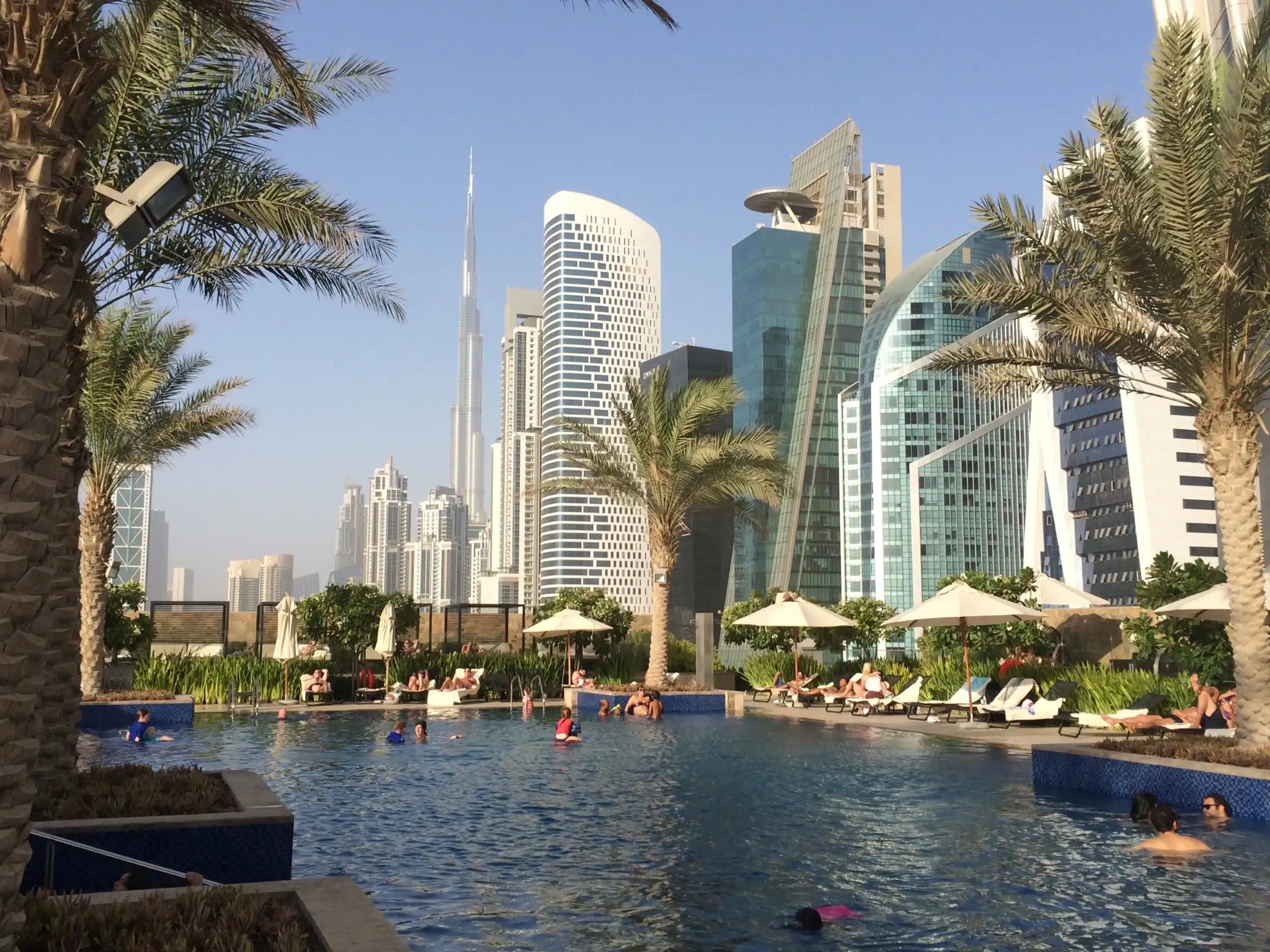
Dubai towers are not merely visual symbols; they form an important part of the city’s economic and tourism identity and affect the value of nearby properties. From supertall towers to office and residential towers, many of Dubai’s important projects have taken shape as vertical developments. Among them, Burj Khalifa, as the most prominent example, with a height of 828 metres, still retains its role as Dubai’s global symbol and is in a sense the city’s visual and tourism focal point.
Why is understanding Dubai towers important?
- Prominent towers such as Burj Khalifa are not only tourist attractions; the surrounding areas are usually stronger in terms of commercial use, hotels, restaurants and urban accessibility as well.
- Non-residential city landmarks such as Dubai Frame and Museum of the Future complete Dubai’s urban identity and are especially important for assessing the attractiveness of the surrounding areas.
- For living and investment, the tower matters less than the tower’s name; what should also be reviewed is the building’s use, management quality, maintenance costs, level of accessibility and the type of surrounding neighbourhood.
From a practical perspective, Dubai’s towers should be examined on three levels: landmark towers (for identity and tourism), commercial towers (for business and employment) and residential towers (for living and investment). This distinction makes decision-making about buying, renting or choosing a place to live more precise, and prevents the choice being made only on the basis of a tower’s reputation.
Dubai Ports
Dubai ports are one of the main foundations of the city’s economic growth, and their role is not limited to sea transport; these ports are directly connected to trade, logistics, employment, warehousing prices and even the attractiveness of the surrounding industrial and commercial areas. At the regional level, Jebel Ali Port is Dubai’s most important commercial port and, because of its high operational scale and connection to a vast logistics network, is considered the city’s main pillar of maritime trade.
Dubai’s important ports and the role of each one
- Jebel Ali (Jebel Ali Port): At the regional level, Jebel Ali Port is the largest container port in the region and Dubai’s main gateway for maritime trade/logistics, and it is connected to a wide network of shipping services and global ports.
- Mina Rashid: An important cruise and maritime tourism hub, while also covering a combination of cruise operations and cargo operations.
- Mina Al Hamriya: A key port for breakbulk cargo, project cargo and general cargo, and alongside cargo vessels it also receives traditional dhows.
- Dubai Creek & Deira Wharfage: Still an important gateway for traditional dhow trade and preserves the historical role of these trade routes.
For anyone intending to live or invest in Dubai, understanding the ports is important because the type of port changes the type of demand in nearby neighbourhoods: areas around commercial ports are more suitable for business and logistics, while areas close to cruise and marina functions can be more attractive for tourism, services and some property projects. This functional difference is entirely decisive when analysing a property location or choosing an area for economic activity.
What is life like in Dubai for Iranians?
For Iranians, living in Dubai is usually more than a purely “migration” decision; it is a combined one: residency, work, income, lifestyle, school/university and cost management. In practice, much of the experience of living in Dubai depends on the channel of entry (work, study, investment or family), where the person chooses to live, and how closely their level of income matches the city’s real costs.
Residency in the United Arab Emirates is generally renewable, and its validity period can be 1, 2 or 3 years (sponsor-based) or 5 and 10 years (long-term routes), depending on the type of visa; therefore, it is better to make decisions from the outset with a time horizon appropriate to the visa type, rather than on impulse alone.
For Iranians, Dubai’s biggest advantage is that the city is fully international and many everyday and professional matters can be managed in English; however, alongside this advantage, issues such as housing rent, health insurance, administrative order, document credit assessment and monthly budget management play a decisive role. If the goal is not merely “being in Dubai” and there is a clear plan from the outset for work, study or investment, the quality of decision-making and the sustainability of life will be considerably better.
Advantages and disadvantages of living in Dubai
Dubai is an attractive option for many Iranians, but that attractiveness turns into a good outcome only when both the advantages and the limitations are seen realistically. The most important point is that Dubai is a city of opportunities, not a city of “guaranteed results”; that is, if the skills, financial plan and residency path are clear, the outcome is usually more reliable.
Advantages
- Diverse and international job market: from sales and services to technology, finance, logistics, tourism and construction, there are more varied opportunities than in many cities in the region.
- Strong urban infrastructure: transport, municipal services, shopping centres, healthcare and digital services are all at a high level.
- Multicultural environment: for Iranians, social adaptation is usually faster than in cities with a more uniform environment.
- Varied residency routes: there are work, study, family and some investment-based residency routes, each with its own specific rules.
Learn more: Dubai laws
Challenges
- High cost of living (especially rent): the biggest financial pressure usually comes from housing rent.
- Serious job competition: in many professions, competition is international and local experience alone is not enough.
- Dependence on residency status: for many people, employment and residency status are interlinked and must be managed simultaneously.
- A costly lifestyle if there is no budgeting: without cost control, even good incomes are spent quickly.
Learn more: Iranian banks in Dubai
How much does it cost to live in Dubai?
The cost of living in Dubai depends entirely on the area, lifestyle and household composition, but in practice it can be said that rent is the most important variable. For a practical estimate, the monthly day-to-day costs of one person (excluding rent) are usually estimated at around AED 4,000 to 6,500 per month (published general averages mention around AED 4,150); however, if there is commuting, eating out or a more consumption-oriented lifestyle, the figure rises. In housing, too, the price difference between areas is very wide, and that is what determines the financial decision.
For realistic budgeting, it is better to break costs into several categories so that a clearer picture emerges. This model is suitable for starting the decision-making process:
- Annual rent (approximate):
- Studio apartment: around AED 30,000 to 70,000
- One-bedroom: around AED 50,000 to 130,000
- Two-bedroom: around AED 75,000 to 220,000
(depending on the area, the age of the building, accessibility and the quality of the project)
- Monthly services and living costs (approximate):
- Monthly day-to-day costs of one person (excluding rent): around AED 3,500 to 5,500
- Water and electricity (DEWA): around AED 600 to 1,200
- Internet and mobile: around AED 300 to 600
- Practical note for families: if there is a school-age child, school fees can be one of the heaviest parts of the budget and should be calculated from the outset alongside rent and transport.
What are the conditions for finding a job in Dubai for Iranians?
Finding work in Dubai for Iranians is possible, but the result depends on three main factors: marketable skills, the working language (English), and the legal route to employment. In practice, employment in Dubai is not simply a matter of “finding a job”; the contract path, work permit and residency status must all proceed correctly at the same time. In the private sector, there are defined frameworks for contracts and work permits, and the employer/applicant must act through that formal route.
For an Iranian applicant, the competitive advantage becomes stronger when there is an up-to-date CV in English, measurable software/technical skills, and the ability to negotiate professionally. Also, in some fields such as sales, real estate, trade, marketing and services, familiarity with the Persian-speaking market can be a real advantage; but in more specialised professions (technology, finance, engineering, healthcare), job standards and sometimes professional licensing matter more than language or networking alone.
In-demand jobs
Dubai and the UAE labour market has, in recent years, moved towards digital skills, analysis, sales and specialised operational roles. In labour market reports, areas such as technology, data, sales, finance, engineering and project management are still seen among the high-demand categories; while sectors such as hospitality, logistics and manufacturing also play an important role in recruitment.
The list below is useful for a quicker assessment of your chances of entering Dubai’s job market:
- Technology and data: software development, cyber security, data analysis; and in high-demand roles, Data & AI Specialists and Cyber Security Professionals are particularly prominent.
- Sales and business development: B2B Sales, Account Management, Business Development
- Finance and accounting: accounting, corporate finance, financial control, financial analysis
- Digital marketing: Performance Marketing, content, CRM, marketing automation
- Engineering and projects: project management, site engineering roles and project coordination
- Hospitality and tourism: hotels, airlines, airport services and related operations
- Logistics and supply chain: especially for trading and import/export companies
Alongside these, broad hiring in the aviation sector and related services also shows that there are opportunities for professional operational and service roles too, especially if English and workplace standards are maintained.
Income in different jobs
Income in Dubai is better assessed with a range-based view rather than a fixed number. Differences between small and large companies, the type of industry, experience, language, commission and benefits (such as housing/transport) can create a wide income gap. For this reason, the figures below are only useful for an initial estimate and job negotiation, and should not be regarded as definitive amounts. The data below has mainly been reported as monthly salary (AED).
| Job group | Approximate monthly salary range (AED) | Explanation |
| Accountant / Senior Accountant | Around 15,000 to 30,000 | Depending on company size and level of experience |
| Finance Manager | Around 35,000 to 55,000 | Higher in large and international companies |
| Digital Marketing (executive to managerial) | Around 18,000 to 75,000 | A very role- and level-dependent range |
| Sales / Business Development | Around 15,000 to 75,000 | Commission is important in many roles |
| Software Engineer / Senior | Software Engineer: around 25,000 to 40,000Senior Software Engineer: around 30,000 to 35,000 | More specialised and senior roles are higher |
| Cyber Security / Data | Around 20,000 to 60,000 | Usually higher in mature digital companies |
| Human Resources (assistant to manager) | Around 18,000 to 35,000 | Managerial roles and HRBP are higher |
| Admin / administrative support | Around 4,000 to 20,000 | The income gap between companies is large |
Some important points for better interpretation of these figures:
- Base salary is not the same as the total package; some companies provide separate benefits.
- In sales and real estate roles, a significant part of income can be commission-based.
- In specialist roles (technology/finance/management), an international CV and strong English have a direct effect on income level.
Learn more: High-paying jobs in Dubai
Suitable jobs for Iranians
For Iranians, “suitable jobs” does not mean jobs that are simply easier to find; rather, they are jobs that create a real competitive advantage. This advantage may come from Persian language skills, an understanding of Iranian customer behaviour, sales experience, technical expertise, or a track record of presentable projects. If this advantage is not clear, entering Dubai’s job market becomes harder and more time-consuming.
In practical terms, these paths are usually more worth considering:
- Sales and consultancy (especially the Persian-speaking market):
- Real estate, investment services, B2B trade, customer service
- Suitable for people with negotiation and networking skills
- Digital marketing and content creation:
- Social media management, Performance Marketing, content creation and SEO
- For people fluent in Persian + English, this creates an important advantage
- Technology and technical roles:
- Programming, data analysis, security, system support
- They are more often hired on the basis of skills and measurable output
- Accounting and finance:
- Especially if there is experience with ERP, reporting and working to professional standards
- Construction, design and project management:
- For people with execution experience, plan reading, project control or site coordination
- Hospitality, tourism and airport services:
- A suitable option for people with service experience, language skills and strong work discipline
In regulated professions (such as some areas of healthcare, law or education), reviewing licences and equivalency of qualifications is usually necessary before taking action. This should be assessed separately from the outset so that time and cost are not wasted.


Studying in Dubai
Studying in Dubai is one of the most important routes into and for temporary/renewable residency for families and students, and it should be assessed in a fully practical way: the quality of the school or university, location, cost, language of instruction, and the ability to manage family life and work at the same time. Dubai has a very wide range of international schools and higher education institutions, and that variety both creates opportunity and makes choice more complex; because the differences in quality, cost and location between options are significant. The list of higher education institutions and their comparative details can be reviewed on KHDA’s system, and universities are spread across areas such as Academic City, Dubai Knowledge Park, Media City and other parts of the city.
From a residency perspective, the student route in Dubai has a clear framework: the educational institution acts as the sponsor, and for issuing a student residency, documents such as passport, photo, medical examination, Emirates ID receipt and health insurance are required. The processing and issuance time, base cost and additional costs are also specified. For financial decision-making, tuition and living costs should be viewed together; because the cost burden is not only from tuition, and accommodation and transport also make up a large share.
Practical points for making a better choice:
- First decide on the area, then choose the institution (the proximity of your home to the school/university has a serious effect on cost and daily time).
- Do not look only at tuition; calculate transport, insurance, food and rent together.
- For university, secure the residency path and document timeline in advance so the semester start is not delayed.
- For schools, assess educational quality and the stability of tuition/other costs at the same time, not just the school’s name.
Frequently asked questions
To live in Dubai, should you find a job first or get residency first?
In many routes, these two are interdependent. In the work route, a job offer and contract are usually the main basis for starting the legal work and residency process. In the study route, the educational institution acts as the sponsor and the student residency proceeds through that route. So there is no single answer for everyone, and the entry route must be identified first.
What is the minimum monthly budget to start living in Dubai?
If a person is single and rent is calculated separately, they usually need to budget around AED 3,500 to 5,500 per month for daily expenses. But a real decision is not reliable without taking rent into account; because rent makes up the largest share of cost in Dubai and the difference between areas is very large.
Can you work and live in Dubai without Arabic?
In many jobs and day-to-day matters, English is sufficient, and this is one of the reasons Dubai is attractive to international professionals. However, in some roles (local sales, certain administrative matters, communication with some clients) knowing Arabic is a significant advantage and can affect how quickly you are hired or your career growth.
Which sectors in Dubai have a higher chance of employment?
Technology, data, sales, finance, digital marketing, project management, logistics and hospitality are among the sectors that usually offer more opportunities. However, “chance of employment” depends on CV quality, relevant experience and language level, and is not guaranteed simply by choosing a sector.
How should job income in Dubai be assessed?
The best method is to look at income as a range rather than a fixed number. Role, experience, company size, industry and benefits all create significant differences in salaries. Also, in some jobs such as sales, final income may depend on commission and may differ from base salary.
What is the point in studying in Dubai that is usually overlooked by students or families?
The most common mistake is looking only at tuition. In practice, the location of the school/university, rent, transport, insurance and daily travel time can change the decision completely. The right choice usually comes from a combination of “educational quality + place of residence + budget”, not just the institution’s name.
For Iranians, is starting with renting better or buying property?
In most life-start scenarios, renting is the lower-risk option because it allows a person to first assess the right area, commuting route, real cost and job stability. Buying property is a better decision when the residency/investment objective is clear, sufficient budget is available, and the area is chosen based on real need rather than advertising alone.
