
The topic of “Iranian banks in Dubai” usually starts with a misunderstanding: that a bank’s presence means the same level of service and frictionless money transfers. The reality in 2026 is that Bank Saderat Iran and Bank Melli Iran are registered in Dubai as licensed foreign banks, but this does not mean a local licence in the sense of being able to freely transfer funds linked to Iran or remove sanctions-related restrictions, and the scope of services, especially “money transfers between Iran and the UAE”, is heavily affected by compliance requirements and sanctions. In this article from Hamed Ghelichkhani, we look at the situation of Iranian banks in Dubai.

Are Iranian banks active in Dubai?
Yes; but “being active” has three meanings that should not be confused with each other:
- Active branch: with a banking licence, the bank can provide banking services (accounts, some foreign exchange/commercial services, etc.), and operates under the supervision of the UAE regulator. In the list of licensed banks, Bank Saderat Iran and Bank Melli Iran are registered in Dubai as Foreign Bank / Conventional Retail.
- Representative office: it usually does not have the right to provide full banking services and mainly serves an introduction/liaison role (which is why it should not be confused with a “branch”).
- Restricted activity: meaning the bank is “open” and provides services, but in some services (especially international payments/transfers and correspondent relationships) it has practical limitations—these limitations usually stem from sanctions requirements and compliance policies.
Learn more: Introducing Dubai (About Dubai and everything you need to know, from 0 to 100)
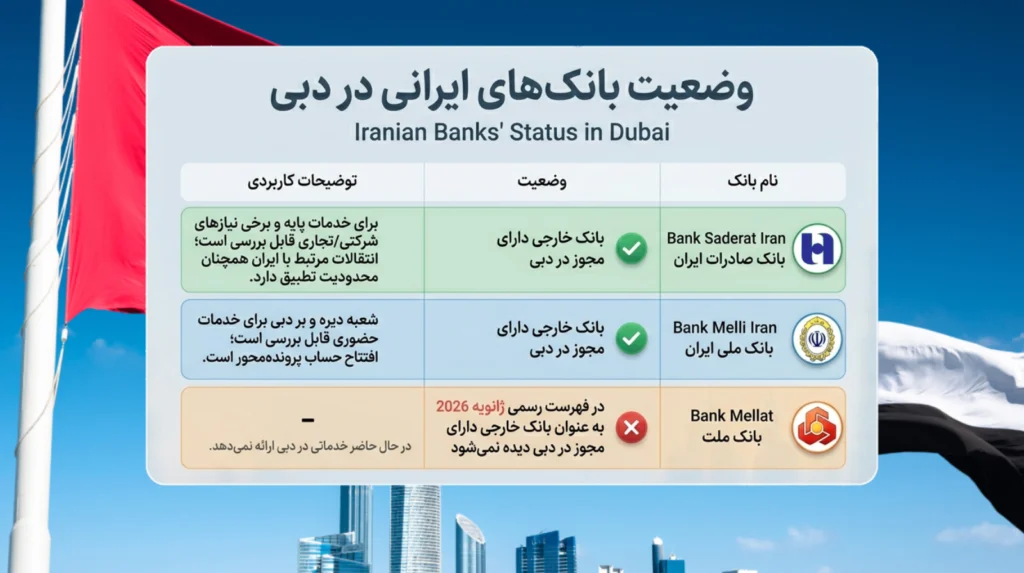
Which Iranian banks have active, licensed branches in Dubai? (Updated 2026)
In the official list of the Central Bank of the UAE (January 2026), the following two Iranian banks are registered in Dubai as licensed foreign banks:
- Bank Saderat Iran
- Bank Melli Iran
What services does Bank Saderat’s Dubai branch provide?
Bank Saderat’s Dubai branch is listed in the UAE’s licensed banks directory (January 2026) as “Foreign Bank / Conventional Retail” with a Head office in Dubai (though not in the sense of the bank’s global headquarters!); in other words, it has an official banking presence from a licensing perspective.
- Realistic expected service type:
- Personal current account with basic facilities such as a cheque book, card/ATM and in-branch services (teller), according to the bank’s official brochures.
- Foreign trade services (such as L/Cs and guarantees) according to fee/service documents published for corporate customers.
Where is Bank Melli’s Dubai branch, and what services does it provide?
Bank Melli’s Dubai branch is also listed in the official Central Bank of the UAE directory (January 2026) as a foreign bank.
At the operational level, Bank Melli Iran states on its UAE unit website that it has two fully fledged branches in Dubai (Main Branch in Deira and Bur Dubai Branch).
- Main advantage for an Iranian user: a physical presence and a more familiar/Persian-language communication channel, especially for some corporate/commercial needs (provided the case is defensible from a compliance perspective).
Does Bank Mellat have an active branch in Dubai?
In the official list of the Central Bank of the UAE for 2026, the name Bank Mellat does not appear among the licensed foreign banks in Dubai. The official Bank Mellat website also does not mention a UAE branch among its foreign branches. Therefore, if you are looking for “Bank Mellat Dubai” to open an account or obtain banking services, unfortunately we must tell you that this bank does not yet have an active branch in Dubai and you will need to use alternative banks.
So, in summary:
Addresses of Iranian banks’ branches in Dubai
| Bank name | Branch / Office | Address | Use for the user | Note before visiting |
|---|---|---|---|---|
| Bank Saderat Iran | Regional office / Al Maktoum branch | Bank Saderat Iran Building, Al Maktoum Street, Deira, Dubai, P.O. Box 4182 | Suitable for in-person and corporate services | Before visiting, confirm the type of service and opening hours. |
| Bank Melli Iran | Dubai Main Branch / Deira | Bank Melli Iran Building, Baniyas Street, Deira-Dubai, P.O. Box 1894 | Suitable for in-person services and basic accounts | Residency documents and KYC requirements are very important. |
| Bank Melli Iran | Bur Dubai Branch | Ahmed Seddiqui Building, Khalid Bin Waleed Street, Bur Dubai, P.O. Box 3093 | Suitable for in-person services in Bur Dubai | Before visiting, confirm that the required type of service is available. |

What services can you get from Iranian banks in Dubai?
The correct picture is this: these banks can cover “basic banking + some corporate/commercial banking”, but in some services (especially sensitive international transfers related to Iran) there are practical limitations.
Learn more: Opening a bank account in Dubai
Limited foreign exchange and financial settlement services
This section usually includes basic functions such as accounts, payments and some transfers within the permitted framework; however, “unlimited” or “easy Iran↔UAE transfer” is not a correct assumption.
- Bank Saderat (example of basic services): current account with cheque book and ATM/Debit, plus in-branch services according to the official brochure.
- Bank Melli (example of banking services): on the UAE unit website, services such as Internet/Telephone/SMS banking and the “Funds Transfer System (FTS)” are listed.
- Key limitation: transfer capacity and limits, especially in relation to Iran, may be restricted by sanctions/compliance policies, and banks usually apply stricter scrutiny to the source/destination of funds.
Services related to companies and foreign trade
In practice, the most reliable part of these banks’ services for many users is “corporate services”; for example, foreign trade tools supported by documents/contracts.
- Bank Melli (Trade Finance): on the UAE unit website, Trade Finance (L/C, guarantee, Trust Receipt, …) is introduced as a service.
- Bank Saderat (Trade Finance/Guarantees): the corporate customer fee schedule includes Trade Finance and guarantee sections.
Support for some financial dealings of Iranians
This phrase must be understood precisely: it usually means solving everyday banking issues for Iranian residents/traders (accounts, specified receipts/payments, corporate services), not that any kind of money transfer between Iran and the UAE can be carried out without obstacles.
- More common uses: corporate accounts for traceable foreign trade operations, or personal accounts for everyday needs within acceptable frameworks.
Learn more: Living in Dubai for Iranians
Services that are not offered
To avoid false expectations, a few things are usually either not offered at all or are, in practice, highly likely to face restrictions:
- Direct and hassle-free Iran-UAE bank transfers like a normal corridor between the two countries (especially through common correspondent/SWIFT routes).
- The range and convenience of digital/app services at the level of major UAE banks (this is an experiential comparison; the decision should be based on real need).
- Any financial service that, from a compliance perspective, is seen as sanction circumvention or involving an unclear source of funds (the risk of blocking/rejecting the transaction rises).

Is it possible to transfer money between Iran and Dubai?
In real, non-promotional terms: yes, money can be transferred, but it is not “like a normal banking route” and in many scenarios it faces serious restrictions/scrutiny. The main reason is clear: Iranian banks, including Bank Saderat and Bank Melli, are named in various sanctions regimes, and UAE banks also have strict compliance policies; the result is that any Iran-related transaction usually receives a higher level of scrutiny.
Official and semi-official ways to transfer money
Without going into illegal routes, the practical picture is this:
- Official methods: transfers carried out through licensed banking/brokerage channels and with complete documents (contract, invoice, source of funds) — but in direct connection with Iran, they may not always be available or may be rejected.
- Permissible non-bank methods: using licensed exchange houses and money transfer institutions in the UAE, provided that KYC/AML requirements are observed and documents proving the source and purpose of the funds are provided.
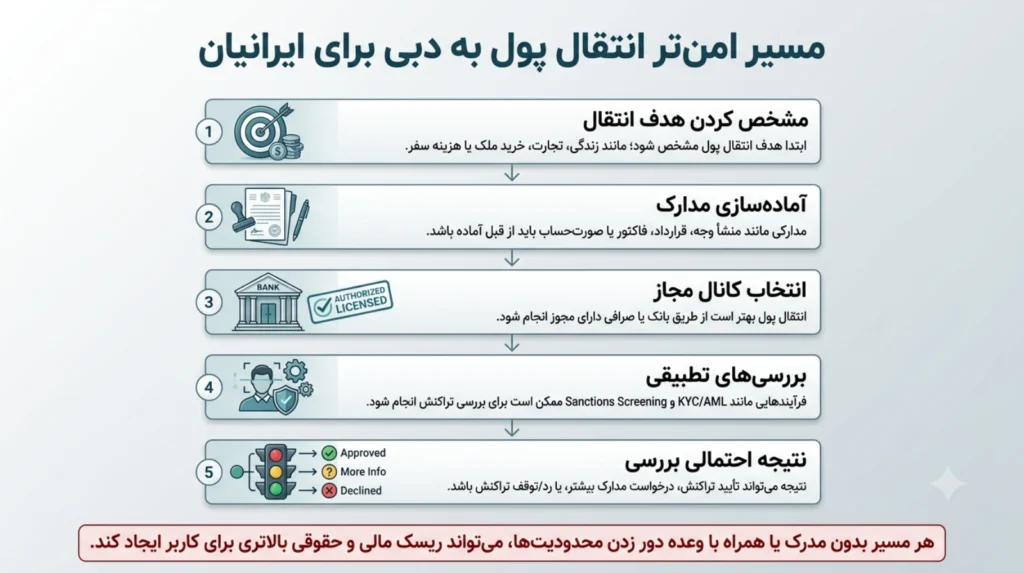
Note for property buyers: If you are going to bring capital into the UAE to buy property in Dubai, review the payment route, source-of-funds documents and transfer timing before reservation or signing the contract. This review may help prevent payment stoppages or delays in the transaction.
Legal and sanctions restrictions
Restrictions are not just “one country’s law”; they are a combination of several layers:
- US sanctions: for some Iranian banks, including Bank Saderat Iran and Bank Melli Iran, there is sanctions documentation, and this affects the behaviour of third-party banks.
- European sanctions developments: for example, in the EU sanctions tracker, the name “Melli Bank plc” appears under the IRAN regime in 2025.
- Compliance by UAE banks: local UAE banks explicitly stress sanctions/embargoes and the consequences of non-compliance; this means transactions linked to Iran are usually treated as high-risk.
The Central Bank of the UAE has published guidelines and frameworks for licensed financial institutions in areas such as Transaction Monitoring, Sanctions Screening and the implementation of Targeted Financial Sanctions. Accordingly, in sensitive transfers or transactions that require further review, checking the transaction parties, source of funds, destination of funds and supporting documents is part of the normal banking compliance process.
Risks and important points for users
- Risk of transaction rejection or suspension: even with documents, a transaction may be stopped or rejected due to the internal policy of the bank/exchange house.
- Risk of temporary freezing of funds until documents are completed: if the source of funds or the purpose of payment is unclear, there is a possibility of a document request and a stop.
- Safe decision-making rule: any channel that “does not require documents” or “promises to bypass restrictions” carries a much higher legal/financial risk and cannot be recommended.
Can Iranian bank cards be used in Dubai?
In most practical scenarios, bank cards issued inside Iran are not reliable for purchases and withdrawals in Dubai; because these cards operate on the Shaparak network, and Shaparak is Iran’s domestic payment network (it covers transactions such as cash withdrawals, purchases, transfers and so on through ATMs and point-of-sale terminals).
Shaparak network status outside Iran
The Shaparak network is inherently designed to connect and settle card-based payments inside Iran; therefore, a direct connection between a “Shaparak card” and common international networks (such as Visa/Mastercard) is not at a level that you can rely on for everyday use in Dubai.
Cash withdrawals, purchases and ATMs
- Using an Iranian card at POS terminals in Dubai: usually does not work, because Dubai terminals operate on international/local payment networks and Iranian Shaparak cards are not connected to them.
- Withdrawing cash from ATMs in Dubai with an Iranian card: usually is not possible or is very limited and unpredictable.
Common alternative solutions for Iranians
Instead of relying on Iranian cards, the more reliable options are usually these:
| Need | Common and lower-risk solution | Practical note |
| Everyday payment in Dubai | UAE bank card (debit/credit) | Requires opening an account with a UAE bank or some banks active in Dubai |
| Access to cash | Carrying cash (within customs rules – carrying cash or portable financial instruments above AED 60,000 or the equivalent must be declared) | It is better to have a budget plan plus an emergency buffer |
| Money transfer/conversion | Licensed exchange houses and money transfer institutions | The source and purpose of the money must always be explainable |
(Routes “without documents” or that “promise to bypass restrictions” carry a risk of freezing and legal consequences.)
Opening accounts in Iranian banks in Dubai
Opening an account in Iranian banks active in Dubai is theoretically possible, but in practice it is entirely case-by-case and depends on residency status, transparency of income/source of funds and the level of compliance (KYC/CDD). In the official documents of Bank Saderat, for personal accounts there is a clear reference to valid passport + visa + Emirates ID.
Is opening a personal account possible?
In normal circumstances, for a “reliable” personal account, having UAE residency and Emirati identity documents (EID) plays a key role. In Bank Saderat’s official examples for current/savings accounts, the basic documents listed include passport, visa and Emirates ID.
- Common basic documents:
- Valid passport + residence visa + Emirates ID
- Depending on the profile, supplementary documents such as an employment/salary certificate or proof of income/source of funds
- Important note: in the UAE banking system, KYC and Customer Due Diligence are a regulatory requirement, and the bank may request additional documents or refuse the case.
Conditions for opening a corporate account
A corporate account is usually stricter than a personal account, because in addition to individual identities, the company activity, ultimate beneficial owner (UBO) and registration documents must be clear. In Bank Saderat’s KYC forms, for self-employed/corporate cases, documents such as Trade License / MOA / Share certificate as well as Bank Statement are mentioned.
- Common corporate documents (practical pattern):
- Trade License
- Memorandum of Association (MOA) / company documents
- Passport + visa + Emirates ID of shareholders and authorised signatories
- UBO declaration + evidence of activity (contract/invoice/website)
Required documents (where legally possible)
To avoid the case getting stuck at the compliance stage, three things are usually best prepared from the outset:
- Complete and consistent identity documents (passport/residency/EID)
- Proof of income and source of funds (salary, contract, bank statement)
- Proof of residence/address within the UAE (for residents, the address in the UAE is part of KYC data)

Advantages of using Iranian banks in Dubai
The advantages are “real but limited” and make more sense for those who already work with these banks or whose financial/commercial ties are Iran-focused.
- Easier language and communication: face-to-face communication / mutual understanding is easier for some Iranian clients.
- Basic banking products within the UAE framework: current/savings accounts and basic services can be provided according to the documents published by the banks.
- Some corporate/commercial services: mechanisms such as Trade Finance and corporate services are visible in banks’ service introductions.
Disadvantages and limitations of Iranian banks in Dubai
The limitations usually appear in three areas: the scope of international services, compliance strictness, and the digital/access experience.
- Practical limitations in some transfers and sensitive correspondent relationships: wherever “sanctions/compliance risk” is high, the likelihood of a transaction being rejected or stopped increases (this is not limited to one bank and is also related to the compliance policies of the banking system as a whole).
- Strict, case-by-case KYC: additional documents may be requested, or account opening/transactions may remain on hold until the documents are completed.
- Service experience and diversity compared with large UAE banks: for some needs (apps, cards, international services, broad ATM networks), local banks are usually the smoother choice.
Comparison of Iranian banks with local UAE banks
A real comparison should be based on “what needs to be done”, not merely on the bank’s name. Iranian banks licensed in Dubai may be useful for some needs (especially basic services and certain corporate cases that can be documented), but for everyday banking with a high level of access (strong apps, card variety, broad international services), local UAE banks usually offer a smoother experience; because their network, correspondent relationships and compliance frameworks are broader.
Differences in services, speed and accessibility
| Criterion | Iranian banks in Dubai | Local UAE banks |
| Everyday banking (card/app/network) | Usually more limited and dependent on internal bank policy | Usually broader and more integrated |
| Corporate/trade services | Can be useful if the case is clear and defensible | Usually a wider range of tools and network |
| International transfers | Friction is higher in scenarios linked to Iran | More feasible, but still subject to sanctions/strict compliance |
| Execution speed | More “case-driven” and dependent on KYC/EDD | Usually faster, though KYC/EDD remains serious |
The main logic behind these differences is the level of AML/CFT/KYC scrutiny and the enforcement of “Targeted Financial Sanctions” across the UAE banking system, which means higher-risk transactions (especially those linked to Iran) are taken into deeper review.
Security, transparency and risk
In the UAE, “security and transparency” are mostly about the fact that banks operate under strict CDD/KYC requirements and immediate enforcement of targeted sanctions; therefore, any channel that cannot properly cover the source and destination of funds carries a higher risk of rejection, suspension or temporary blocking—whether it is an Iranian bank or a UAE bank.
- Transactions that in any way become linked to sanctioned entities carry a higher risk (including under US/European sanctions regimes).
- The practical result for the user: whenever the goal is “transfer between Iran and the UAE”, you should expect more checks and the possibility that the transaction will not go through.
Who are they suitable for?
- Iranian bank in Dubai: for those whose needs are specific, documented and close to Iranian/Persian-speaking cases (for example, some corporate cases or basic services within an acceptable framework).
- UAE bank: for those whose goal is modern everyday banking, broad digital services, cards, and easier access to financial services inside the UAE.
Who are Iranian banks in Dubai suitable for?
These banks become a more logical choice when the “issue” matches the capacities they actually offer, rather than expecting a friction-free Iran↔UAE money transfer network.
- More suitable for
- Iranian residents who need basic account services and in-person visits, and whose income source is clear.
- Companies whose business case is documented and can be presented in a defensible way from a compliance perspective.
- People who prefer their interactions with the bank to be closer to a more familiar language/culture, where possible.
- Less suitable for
- Those whose main priority is an “international bank card, advanced app, or smooth global services”.
- Those looking for sensitive or ambiguous transfers, or who cannot provide source/destination-of-funds documents (the risk of suspension increases).
The future of Iranian banks in Dubai
In 2026, any discussion about the future must be based on “observable realities”: the intensity and scope of sanctions, and the level of compliance strictness in the UAE banking system. At present, the UAE’s overall regulatory direction is towards strengthening the AML/CFT/CPF framework and increasing sensitivity to international risks.
The impact of sanctions on the future of banking activity
- At the US level, some entities linked to Iranian banks appear on sanctions lists, and this has a direct effect on the behaviour of banks and brokers.
- In Europe too, sanctions have been reported as having returned from 2025, and names have been recorded in sanctions trackers; this means compliance risks for transactions linked to Iran will not fall unless a legal/political change occurs.
- In the UAE, the requirement to implement targeted sanctions immediately and the expansion of AML/CFT/CPF guidance mean risk-control standards remain stricter.
Possible scenarios ahead
- Dominant scenario (continuation of the current situation): activity continues, but with greater focus on transparent cases and higher restrictions on high-risk transactions.
- Tighter scenario: increased compliance pressure and lower risk tolerance, which could lead to slower account opening/transfers.
- Improvement scenario (conditional on sanctions changes): if sanctions regimes change, brokerage channels could become smoother; however, this scenario cannot be timed or guaranteed.
Important points before using Iranian bank services in Dubai
The checklist below helps you make a practical, lower-risk choice from the outset:
- Define the type of presence precisely: active branch or representative office (the scope of services differs).
- Be clear about the purpose of use: everyday account? trade? receiving/paying? If the purpose is vague, the likelihood of the case being halted is higher.
- Take KYC seriously: documents showing the source of income, contracts, invoices and an explanation of the purpose of the transaction must be available for submission.
- For money transfers, only use authorised channels: using unauthorised institutions can carry both financial risk and legal risk; regulatory action against breaches is real.
- Also consider a local account as an operational option: for cards, everyday payments and digital services, local options are usually smoother.
Final summary
In 2026, “Iranian banks in Dubai” can be useful for some banking needs and certain documented corporate cases, but they should not be chosen with the idea of a “convenient banking bridge between Iran and the UAE”. If the goal is everyday banking, cards, digital services and fast access, local UAE banks are usually the more practical choice; if the goal is specific, documented cases requiring Persian/Iranian communication, an Iranian bank may be an option worth considering—provided the realities of compliance and sanctions are accepted.
User FAQs
Is there really an active Iranian bank in Dubai?
In the list of banks licensed by the UAE Central Bank (January 2026), Bank Saderat Iran and Bank Melli Iran are registered as foreign banks.
Does Bank Mellat have an active branch in Dubai?
In the official UAE Central Bank list for January 2026, Bank Mellat does not appear as a licensed foreign bank in Dubai. Therefore, before taking any action, the licence, type of presence and possible services of this bank should be checked from official sources.
Is money transfer between Iran and the UAE possible?
It may be possible, but it is not “normal and frictionless”. Transactions linked to Iran usually face higher compliance sensitivity and there is a risk of rejection/suspension.
Can you pay in Dubai with a Shetab card?
As a rule, a Shetab card should not be considered the main payment solution in Dubai. More stable options include a UAE bank card, a valid international card or using a licensed exchange house.
What matters most when opening an account?
Valid residency/ID documents, transparency of income source and the purpose of using the account, and accurate completion of KYC.
If the goal is only everyday life in Dubai, is an Iranian or UAE bank better?
For cards, payments, apps and everyday services, a UAE bank is usually more operationally practical; an Iranian bank is more useful when there is a specific documented case-based need.
Where is Bank Saderat’s Dubai branch?
The regional office / Al Maktoum branch of Bank Saderat Iran is listed in Deira, Al Maktoum Street, P.O. Box 4182. Before visiting, it is better to confirm the opening hours and whether the required service is available.
Where is Bank Melli’s Dubai branch?
Bank Melli Iran in Dubai has a Dubai Main Branch in Deira and a Bur Dubai branch. To see the exact address of each branch, refer to the address table in this article.
For buying property in Dubai, is an Iranian bank better or a UAE bank?
In property payments, more important than the bank’s name are the transparency of the source of funds, the legality of the transfer route, and the acceptance of documents by the bank or exchange house. Before making the initial payment, it is better to review the financial route and the required documents.
