
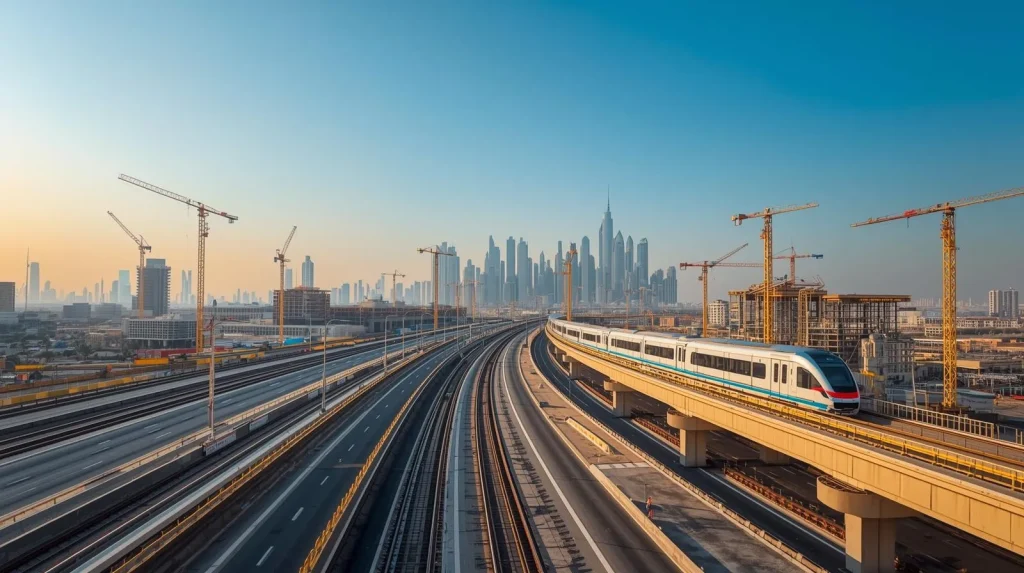
A future being built today
Over the past three decades, the world has witnessed one of the most remarkable urban development stories; a story known as “Dubai”. A city that, in the mid-1990s, had a population of less than 700,000 people now houses more than 4 million people in 2025. This unprecedented growth is not a coincidence, but the result of deliberate planning, smart policymaking and bold decision-making.
But the story does not end there. According to the “Dubai 2040” master plan, the city’s population will reach 5.8 million over the next 15 years. That means adding around another 2 million people to a population that is already forming one of the world’s most dynamic markets. The question in every analyst’s and investor’s mind is:
Is Dubai ready for such growth?
The answer is clear: yes, and even beyond that. Dubai is not only ready, but is also building infrastructure that will provide the capacity for this population to live, work and invest at the highest global standards.
From 1995 to today: population growth that transformed the economy
If we look at Dubai’s historical population growth map, the numbers speak for themselves. In 1995, the population of this emirate was only around 690,000. In the 2000s, this figure passed the 1.5 million mark, in 2010 it reached more than 2 million, and in 2025 it has now reached around 4 million people. In other words, in just three decades, the population has increased more than 6-fold.
This growth is the result of three key factors:
1. An open, expatriate-friendly economy that attracted global talent and labour.
2. Massive investment in infrastructure and transport, which made the city efficient and liveable.
3. Political stability and clear investment laws, which built investor confidence.
Dubai today is home to more than 200 different nationalities. The city’s multicultural and international demographic mix has turned it from a local market into a global platform for trade, real estate and investment.
The 2040 horizon: a population of 5.8 million and an economy twice as large
The Dubai Government, with realism and boldness, has already begun planning for 2040. Based on official estimates, Dubai’s resident population will rise from 3.8 million at the end of 2024 to 5.8 million in 2040. This 50% increase is in itself a challenge, but at the same time it is a historic opportunity for economic growth.
The backbone of this vision is an ambitious economic programme called the “D33 Economic Agenda”; a plan whose aim is to double the size of Dubai’s economy and foreign trade by 2033. Under this programme, the emirate’s total economy will reach USD 8.7 trillion by then, and the city will become the world’s fourth-largest financial centre alongside New York, London and Singapore.
Population growth, economic development and trade expansion are three intertwined axes that form the driving force behind Dubai’s future. And this engine cannot work without massive infrastructure. That is why, over the next decade, we will see a wave of infrastructure projects, each unprecedented on a global scale.
Al Maktoum International Airport: the air artery of the future economy
At the heart of these developments is the expansion project for Al Maktoum International Airport; a plan with a budget of AED 128 billion (around USD 35 billion) whose aim is to turn this airport into the largest airport in the world.
In its final phase, the airport will include 5 parallel runways, 400 passenger gates and more than 100,000 square metres of commercial and retail space. Its final capacity is forecast to handle 260 million passengers a year; that is, more than twice the entire population of Japan!
The first phase of the project will be completed by 2030 and will provide a capacity of 130 million passengers a year from the outset. This project will not only transform the tourism industry, but will also directly affect the real estate, transport and logistics markets. Areas such as Dubai South, Expo City and Al Jaddaf are within the direct influence zone of this development and are rapidly turning into new investment hubs.
Dubai Metro 2040: a city without distance
If we want to name Dubai’s most prominent symbol of urban development, the metro is undoubtedly at the top of the list. Dubai is carrying out one of the largest rail transport projects in the Middle East. The length of the city’s metro lines, which currently stands at 89 kilometres, will reach 421 kilometres under the 2040 plan; that is, an increase of nearly 5 times.
Along this path, the Blue Line, as the newest metro project, is under construction with a length of 30 kilometres and 14 new stations, and will open by 2029. This new network will connect growing areas such as Dubai Creek Harbour, Mirdif, Al Warqaa and Dubailand to the metro. Extending the metro network will transform Dubai from a car-dependent city into a transit-oriented city; a change that will sustainably increase the value of properties around stations.
Tasreef project: urban security for the next 100 years
The heavy rainfall of 2024 showed that Dubai’s surface water drainage system needed upgrading. The government’s response was the huge “Tasreef” project; a modern system for collecting and conveying rainwater, being implemented at a cost of AED 30 billion (USD 8 billion).
This project will increase surface water drainage capacity by up to 700% and can manage more than 20 million cubic metres of water per day. Its full completion is forecast for 2033.
In addition to rainwater management, “Tasreef” plays a key role in recycling and storing water resources for urban green space. In simple terms, this project ensures that even in the event of torrential rainfall, Dubai remains dry, safe and liveable.
New sewerage network: infrastructure worth USD 22 billion
One of Dubai’s most ambitious infrastructure plans is the new strategic sewerage network, which is being implemented with a budget of around AED 80 billion (USD 22 billion). This system includes two main tunnels 75 kilometres long and more than 140 kilometres of secondary branches, laid at a depth of 90 metres underground.
Unlike the current system, which relies on pumping, the new plan will be based on natural gravity flow and will sharply reduce maintenance costs. Its completion will prepare the city for decades in terms of public health, sustainability and urban services capacity.
Dubai Walk: a city for people, not just cars
One of the most inspiring elements of Dubai 2040 master plan is the “Dubai Walk” programme; a 6,500-kilometre network of pavements and cycling paths that will be created across the city by 2040.
The aim is to turn Dubai into a “20-minute city”; meaning 80% of everyday life needs are met within a 20-minute radius of one’s place of residence. The first phase of this plan will begin by 2027, with the construction of 17 kilometres of model pedestrian walkways in Al Ras and around the Museum of the Future.
Expanding walking routes, building 110 pedestrian bridges and underpasses, and developing public spaces are a major step towards a sustainable, people-centred city. The end result will be greater neighbourhood appeal, a boost in urban tourism and growth in the value of residential properties.
Tram and Smart Transport
Dubai is also expanding its tram network. The second phase of development, with a length of 6.5 kilometres, will cover 9 new stations from Dubai Marina to Mall of the Emirates and Burj Al Arab. This route will be completed by 2027 and will play an important role in connecting coastal and tourist areas.
In parallel, smart transport projects including autonomous vehicles, BRT lines and integrated digital payment systems are also on the agenda.
Therme Dubai: Health, Tourism and Wellbeing
Among the technical projects, a unique plan has also attracted global attention: Therme Dubai – the world’s largest and tallest indoor wellness and hydrotherapy complex.
This project, with an investment of AED 2 billion (around USD 550 million), will be completed by 2028 and will have the capacity to welcome 1.7 million visitors a year. Therme Dubai will include an artificial rainforest, thermal pools, botanical gardens and natural waterfalls in a space of more than 500,000 square feet.
This project will not only help improve residents’ quality of life, but will also turn health tourism into one of the drivers of Dubai’s economic growth.
The Impact of These Infrastructure Projects on the Property Market
Population growth to 5.8 million means higher demand for housing, office space, shopping centres and public services.
Each of these infrastructure projects directly affects property values and investment opportunities.
For example, the development of Al Maktoum Airport will multiply the value of land and projects in Dubai South in the coming years. The expansion of the metro and tram will turn the neighbourhoods around the stations into “smart investment” areas. Projects such as Dubai Walk and Therme Dubai will also increase the appeal of lifestyle in the city centre areas, which in turn strengthens demand for luxury apartments.
For investors, this means entering a new phase of growth in Dubai’s property market – a phase built not merely on current demand, but on future infrastructure.
Dubai 2040; a City for Living, Working and Investing
Everything we have discussed paints a picture of a city that builds the future before it arrives. From transport infrastructure to water and sewage technologies, from wellbeing projects to economic policies, everything in Dubai revolves around one goal:
Building a global city for 5.8 million successful, forward-looking people.
In a world where many economies are facing recession, reverse migration and declining investor confidence, Dubai is moving in a completely different direction: a path of growth, stability and global relevance. And on this path, Dubai’s property market not only benefits from these developments, but also becomes one of the pillars of economic growth. Today, investing in Dubai is no longer just buying a property; it is investing in the future of a city that is redefining the future of the Middle East.
Author: Hamed Ghelichkhani
