
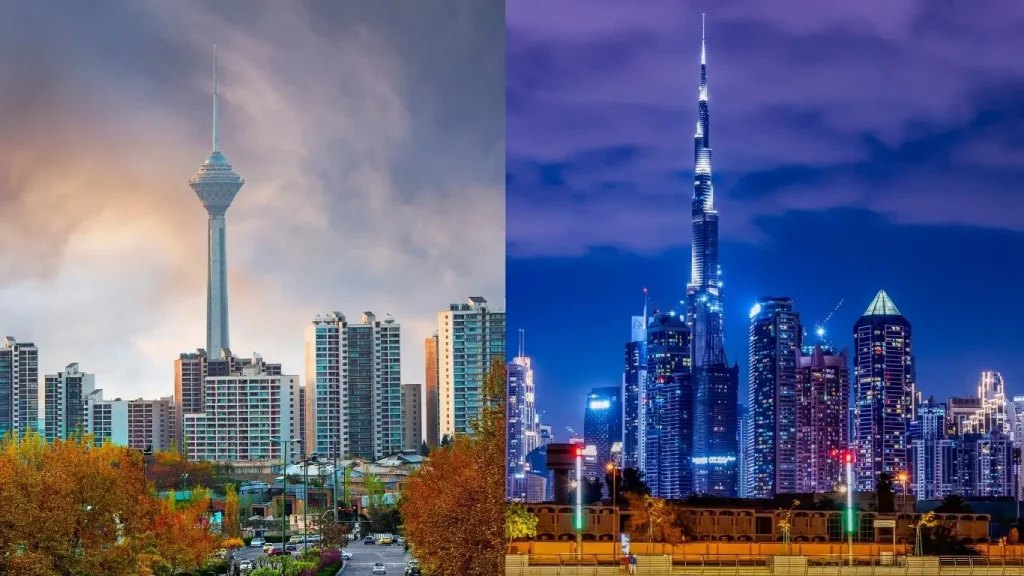
Comparison of Tehran and Dubai from the perspective of quality of life and property investment in 2026 offers a clear picture of two entirely different paths. While Tehran, as the economic heart of Iran, faces inflationary pressures, restrictions on foreign investment, and a decline in the value of the rial, Dubai is consolidating its position as one of the main destinations for international real estate investment. For a precise comparison of Tehran and Dubai, stay with us until the end of this article on the Hamed Ghelichkhani website.

Living costs, income, tax and investment opportunities in these two cities differ significantly. The table below provides a general comparison between Tehran and Dubai in terms of key economic and urban indicators:
| Indicator | Tehran | Dubai |
| Resident population | About 9.6 million people | About 4 million people |
| Daytime population | About 12 million people | About 5 million people |
| Average monthly income | About USD 350 to 400 | About USD 4,200 to 4,300 |
| Average property price (per square metre) | About USD 1,200 | About USD 5,600 |
| Personal income tax | Yes (indirect) | No |
| Average rent for a one-bedroom apartment in the city centre | About 30 to 40 million tomans | About AED 7,000 to 9,000 |
| Real estate market value | Inflation-driven, domestic | Dollar-based and international |
| Foreign expatriate population | Less than 1% | More than 90% |
In the following sections, we will compare Dubai and Tehran from various angles, especially in terms of property investment and living costs, to provide a clearer outlook for buyers and investors.
Learn more: Introducing Dubai
Comparison of Dubai and Tehran in terms of buying property
The real estate markets in Dubai and Tehran differ fundamentally. Tehran is a rial-based and domestic market, while Dubai is regarded as a global dollar-based market. In Tehran, inflation and the decline in the national currency’s value have led to nominal price growth, whereas in Dubai price growth is mainly driven by genuine demand and foreign investment.
In Tehran, the average property price in 1404 is around 90 to 120 million tomans per square metre, while the cost of buying property in Dubai, based on the average price per square metre in mid-market properties, is reported at around USD 5,600 per square metre, and in luxury areas at between USD 7,000 to 11,000 per square metre.
This difference is not only due to the value of the national currency, but also reflects the fundamental difference in the property investment market of the two cities.
Differences in property purchase laws in Tehran and Dubai
In Tehran, buying and selling property is permitted only for Iranian citizens, and foreign nationals can acquire limited ownership only under special conditions and with government permits. On the other hand, land and apartment ownership in Iran is always subject to state and transfer regulations, and freehold ownership for foreigners is not available.
However, in Dubai, the ownership system is completely transparent and comes in two types:
- Freehold (full ownership): in designated areas, foreign investors can own 100% of the property and land.
- Leasehold (long-term letting): 99-year ownership for foreign nationals in some areas.
In addition, by purchasing a property worth at least AED 2 million, it is possible to obtain a 10-year Dubai residency (Golden Visa). As a result, Dubai’s ownership laws are far more attractive and more investment-friendly than Tehran’s.
Differences in property purchase costs in Tehran and Dubai
In Tehran’s market, prices are set in rials and exchange-rate fluctuations directly affect purchasing power.
In 2026, the average housing price in Tehran is around USD 900 to 1,200 per square metre. In the northern luxury districts of the city (such as Elahieh and Zafaraniyeh), this figure rises to more than USD 2,250 per square metre, and in some cases has even exceeded USD 10,000 per square metre.
By contrast, in Dubai, one of the most luxurious cities in the UAE, apartment prices in standard areas range between AED 15,000 to 17,000 per square metre (about USD 5,000 to 6,500), while in luxury areas such as Palm Jumeirah or Downtown Dubai they trade at between USD 7,500 to 8,500 per square metre.
Although the price per square metre in Dubai is several times higher than in Tehran, due to higher incomes and loans with competitive rates based on EIBOR and relatively high LTV limits, access to home ownership is far easier for Dubai residents.
Differences in property tax in Tehran and Dubai
In Iran, property buyers must pay transfer tax, municipality charges and notary office fees. In addition, tax on vacant homes has been introduced in recent years, placing additional pressure on owners.
In Dubai, unlike Tehran, there is no income tax or property tax. The only costs payable are transfer of ownership fees (4%) and annual building service charges (Service Charge). This simple and transparent tax structure has made Dubai one of the most attractive property markets in the world for international investors.
Comparison of Dubai and Tehran in terms of living costs
Living costs in Dubai are higher than in Tehran, but this difference is offset by higher income levels. Based on 2026 data, the average monthly cost of living in Dubai for one person is about AED 7,000 to 8,000 (around 80 to 90 million tomans), while in Tehran this figure is estimated at around 30 to 40 million tomans.
In Dubai, housing rent, education and transport costs are higher, but on the other hand public services, safety, infrastructure and quality of life are much better. Meanwhile, the absence of income tax in the UAE means real salaries (net take-home pay) are higher in Dubai than in Tehran.
In simple terms, although the cost of living in Dubai is higher, the economic capacity of residents is also several times greater than the Tehran average; a factor that makes investing in Dubai not only profitable, but also a safe way to preserve asset value against inflation.
Comparison of Dubai and Tehran in terms of business and company incorporation
Tehran and Dubai have followed two completely different paths in terms of the business environment.
In Tehran, the economic structure is largely state-led, and bureaucratic obstacles and international sanctions have made foreign investor attraction very limited. Starting a new business in Tehran requires multiple permits, high taxes and a complex administrative process.
By contrast, Dubai is regarded as one of the simplest and most attractive markets in the world for starting a business. The UAE’s economic system is built on free trade, foreign investment and digital infrastructure.
Key business features in Dubai in 2026:
- Company incorporation in less than 7 days (fully online)
- Exemption from personal income tax
- 100% company ownership possible in Free Zone areas
- Access to international markets through global ports and airports
- High political and economic stability
As a result, many Iranian entrepreneurs facing domestic constraints have been able to expand their activities into international markets by transferring their capital to Dubai.

Comparison of Dubai and Tehran in terms of population
In terms of population, Tehran is larger, but Dubai is more influential.
| Indicator | Tehran | Dubai |
| Resident population (2025) | around 9.6 million | around 4 million |
| Daytime population (including commuting for work) | more than 12 million | around 5 million |
| Population density in the city centre | very high | relatively low, with precise urban planning |
In Tehran, the high population density and uneven urban development have placed a great strain on infrastructure. In Dubai, however, urban development is carried out in a planned, modern and intelligent manner. Residential, commercial and leisure areas are designed so that traffic and congestion are kept to a minimum.
For this reason, although Tehran is more populous, Dubai is several steps ahead in terms of quality of life, security and urban management.
Comparing Dubai and Tehran in terms of public transport
With a daytime population of more than 12 million, Tehran has an extensive transport system; the metro, Bus Rapid Transit (BRT), taxis and smart transport systems are active in most areas. However, heavy traffic, air pollution and ageing vehicles are still among the capital’s main problems.
By contrast, Dubai’s transport system is one of the most advanced systems in the Middle East.
Brief comparison:
| Mode of transport | Tehran | Dubai |
| Metro | large but crowded | modern, automated, fully air-conditioned |
| Taxis and apps | varied but with heavy traffic | smart taxis and no cash needed |
| City buses | extensive but slow | equipped with GPS and precise order |
| Tram | limited | operating in Marina and Jumeirah |
| Bicycles and city scooters | under development | fully smart and available to the public |
By implementing projects such as driverless metro, aerial taxi and green cycling routes, Dubai has turned itself into a forward-looking and efficient city.
While Tehran is still grappling with the challenges of ageing infrastructure, Dubai is moving rapidly towards clean and smart transport.
Comparing Dubai and Tehran in terms of leisure
In this section, the difference between the two cities is more apparent than in any other area.
Dubai, with more than 65 shopping centres, dozens of water parks, luxury hotels, public and private beaches, and attractions such as Burj Khalifa and Dubai Mall, is considered one of the world’s leading tourist destinations. The city is active 24 hours a day, and tourism makes up an important part of its economy.
By contrast, Tehran also has a variety of leisure facilities; from hiking in Darband and Darakeh to shopping centres and cafés in the north of the city. However, cultural restrictions, the high cost of foreign travel and the lack of international facilities have made Iran’s capital more of a city for work and everyday life than a leisure destination.
At a glance, Dubai is a city for luxury living and round-the-clock leisure, while Tehran is more of a city for traditional and family living.
Comparing Tehran and Dubai in terms of the job market
Tehran’s job market is heavily dependent on the state and quasi-state structure. Employment opportunities in the private sector are more limited, and many graduates face difficulties in finding work. The average monthly salary in Tehran is around 15 to 20 million tomans, which, when taking living costs into account, gives people very little ability to save.
In Dubai, however, the job market is built on skills, English language ability and international expertise. Salaries in the UAE are generally contracted in dirhams (AED); valuation has a dollar effect, but the payment currency is not the dollar.
and there is no income tax.
Average salaries in Dubai (2026):
- Administrative and technical roles: AED 10,000 to 15,000
- Management roles: AED 20,000 to 40,000
- Finance, medical and technology specialists: more than AED 50,000
While many Iranians obtain several times the income in Dubai through work migration compared with Tehran, job security, quality of life and professional growth are also much higher in the UAE.
Ultimately, although competition in Dubai’s job market is high, for skilled, multilingual and internationally experienced people, this city is considered one of the region’s most advantageous job markets.

Comparing Tehran and Dubai in terms of education (school and university)
The education systems of Tehran and Dubai follow two completely different paths.
In Tehran, the education system is more focused on state schools and the university entrance exam. Although non-state, international and gifted schools are also active, educational quality is uneven at a broader level, and many students migrate abroad to continue their studies. Iran’s top universities such as Tehran, Sharif and Amirkabir are ranked regionally, but they still remain far from global standards.
By contrast, Dubai has become one of the Middle East’s international education hubs. The city hosts more than 220 private schools, with British, American, Canadian and IB systems. Many migrant families choose Dubai because of the high quality of education for their children.
In higher education, well-known global institutions such as University of Birmingham Dubai, Heriot-Watt University and Canadian University Dubai are active in the city and offer international degrees.
For this reason, Dubai is an ideal destination for international study and the academic development of children, while Tehran still has a more traditional education system.
Comparing Tehran and Dubai in terms of culture and society
Tehran is a city with deep Iranian history, culture and traditions. Its identity is shaped by family, religion and national heritage, and these aspects have helped sustain social relations. However, cultural restrictions and class differences have limited individual freedoms and modern lifestyles for many citizens.
By contrast, Dubai is a blend of more than 200 different nationalities, and its lifestyle is international and multicultural. Freedom of dress, food diversity, religious freedom and equal opportunities are among the key features of Dubai’s society.
Dubai is a migrant-friendly society that provides opportunities for life and progress for all nationalities; as a result, the social quality of life in Dubai is significantly higher than in Tehran, especially for those looking for a freer and more global cultural experience.
Comparing Tehran and Dubai in terms of security and quality of life
In terms of security, both cities have relatively good conditions in the Middle East region, but Dubai is known as one of the safest cities in the world. The crime rate in the city is very low, and the UAE government has strict laws to maintain social order.
By contrast, despite relative stability, Tehran faces challenges in areas such as theft, urban accidents, pollution and ageing infrastructure.
In terms of quality of life, the Mercer global index in 2025 placed Dubai among the world’s top 50 cities in terms of “well-being, security and public amenities”, while Tehran is placed in the lower half of the table.
In fact, Dubai is a city for modern, safe and international living, while Tehran is more of a city for family life with a traditional structure.
Conclusion
Comparing Tehran and Dubai shows that these two cities are two different worlds in one region. Tehran is a populous, cultural and historic city, but one that is dealing with challenges such as inflation, traffic, pollution and a lack of international opportunities. By contrast, Dubai is a modern, wealthy city with a global open economy that has strong appeal for living, working, studying and investing.
If your goal is smart investment or migration, buying property in Dubai can be a more secure route. With buying property worth more than AED 2 million, you and your family can obtain UAE residency. On the other hand, the steady growth of the Dubai properties market and government support policies have made it one of the safest investment destinations in the world. If you are looking for a better lifestyle, a more secure future and US dollar capital growth, Dubai is your choice.
Frequently Asked Questions
Is buying property in Dubai allowed for Iranians?
Yes, Iranians can have 100% ownership in Freehold areas of Dubai and obtain residency through it.
What is the minimum investment required to buy property in Dubai and obtain residency?
For 2-year residency, there is no minimum, and you only need to own a property. For 10-year residency, you must buy a property with a minimum value of AED 2 million.
How much higher is the cost of living in Dubai compared with Tehran?
On average, the cost of living in Dubai is about 2.5 to 3 times higher than Tehran, but incomes are also several times higher.
Is it possible for Iranians to incorporate a company in Dubai?
Yes, Iranians can incorporate a company in Free Zone areas and have full ownership.
Can residency in Dubai be obtained through study?
Yes, students can obtain a study visa and then apply for work or investment residency.
How does the safety of living in Dubai compare with Tehran?
Dubai is one of the safest cities in the world and its crime rate is far lower than Tehran’s.
Is there tax in Dubai?
No, there is no personal income tax in Dubai, and only corporate tax and value added tax are applied.
What is the difference in property prices between Tehran and Dubai?
In average areas of Tehran, the price per square metre is around USD 1,200, while in Dubai it varies between USD 5,000 and USD 9,000.
Which is the best area in Dubai to buy property and obtain residency?
Palm Jumeirah, Dubai Marina, Downtown and Jumeirah Village are among the most popular areas for living and investment.
