
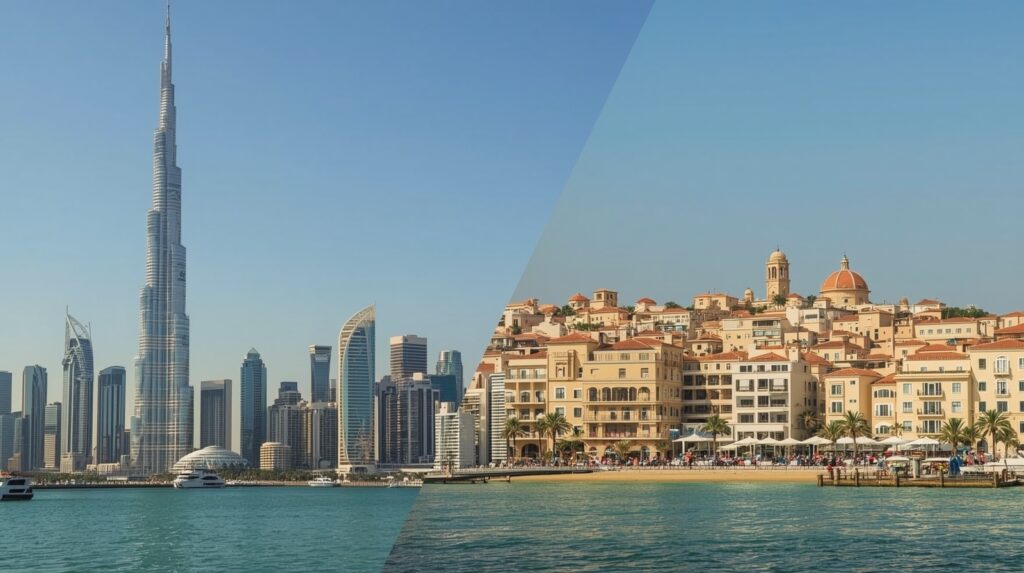
Is Buying Property in Dubai Better or Spain? This is a question that many investors, especially those who are thinking about both return on investment and residency, ask themselves. There is no single, definitive answer for everyone; because the choice between Dubai and Spain depends on personal priorities, risk tolerance, investment horizon, and the main objective (profit only, or profit + residency + lifestyle).
According to official Dubai data, the property market in 2025 has shown significant growth in terms of transaction value and number of transactions, as well as the value of lease contracts. By contrast, Spain is a mature European market, but it has also seen notable price growth in 2025.
On the other hand, there is a serious difference in the relationship between “buying property” and “residency”. In the UAE, property ownership at a certain value can open the way to obtaining medium-term residency or even a 10-year Golden Visa. In Spain, however, the Golden Visa programme based on property purchase was officially stopped in 2025, and buying property on its own is no longer considered a direct route to investment residency. In the rest of this article from Hamed Ghelichkhani, we examine whether buying property in Dubai is better or Spain.
To make the initial picture clearer, the table below provides a brief overview of the key differences between Dubai and Spain:
| Topic | Dubai | Spain |
| Market type | A highly active market with a high volume of transactions and investment growth (with greater volatility than mature markets) | A mature European market, but in 2025 price growth has not necessarily been “modest”; according to official INE data, annual house price growth in Q3 2025 was recorded at 12.8%. |
| Average rental yield | Yield is area-based – no exact figure is specified | Generally around 3.0 to 3.4%, depending on the city and property type; in practice, often lower than Dubai |
| Relationship between property purchase and residency | Possibility of obtaining a residency visa for property owners; including a 10-year Golden Visa for property with a minimum value of AED 2 million and some short-term owner visas | The Golden Visa programme based on property purchase has been cancelled; buying property may help strengthen certain visa types (such as self-sufficient or digital nomad visas), but the purchase itself does not guarantee residency |
| Income tax on rental income | Direct tax on personal income, personal investment income and property investment income (for individuals) is not normally collected; however, fees, municipal levies and service charges do exist | For non-residents, the general rental tax rate is usually 19% for residents of the EU/Iceland/Norway and 24% for others. |
| Stability of laws and legal framework | A relatively transparent framework with rapid reforms; however, the pace of regulatory change is high in some areas and up-to-date monitoring is necessary | European Union legal framework, stability of property rights, but there is a possibility of changes to tax or immigration laws over the medium-term horizon |
| Suitable audience | Individuals with a higher risk tolerance who care about rental yield and capital growth and are looking for residency in the commercial-financial environment of the Gulf region | Those who place greater importance on a European lifestyle, access to the European Union, education and social welfare, and are willing to accept average but more stable returns |
In the following, each of these aspects is examined in more detail so that a more logical decision between “Dubai or Spain” for buying property can be made.
Read more: Migration to Dubai

Property Market Conditions in Dubai and Spain
The Dubai property market has experienced several up and down cycles over the past decade, but in 2023 and 2024 it re-entered a phase of strong growth. According to the annual DLD report, the total value of property transactions in 2024 reached AED 760.99 billion (20.4% annual growth), and the average price per sq.meter in the apartment and villa segments reached new highs. This growth has been supported by factors such as population growth, infrastructure development, tourism growth and Dubai’s appeal as a regional hub for trade and technology.
Compared with Dubai, the Spanish market has a more mature structure and most of its transactions take place in the secondary market. After the debt crisis and housing bubble of the previous decade, this market has been moving for years along a path of controlled and modest growth. In many cities, annual price growth has been in the range of a few per cent, and volatility has been much lower than in markets such as Dubai. In cities such as Madrid and Barcelona, demand pressure and supply shortage have led to significant increases in prices and rents, but on a national scale the market behaviour is more modest and balanced.
There is also an important structural difference:
- In Dubai city, a high share of transactions relates to foreign buyers and investors, and off-plan projects play a major role in the market.
- In Spain, the secondary market accounted for around 91% in 2024 and new-builds for about 9%; the share of foreign buyers in total transactions was also recorded at 19.1%.
In short, Dubai’s market is dynamic, growth-oriented and somewhat volatile; whereas Spain’s market is more mature, with slower but more predictable growth. The choice between the two depends on how an investor balances “potential growth” against “peace of mind and stability”.
Comparing Price Growth and Investment Returns in Dubai
In the discussion of “Is Buying Property in Dubai Better or Spain?”, the first criterion is usually the return on investment; that is, the combination of property price growth and rental income.
The capital growth of buying property in Dubai has been attractive for many investors in recent years:
- The DLD report states officially that apartment prices grew by around 32% from 2021 to 2024, and villa prices increased by around 93% from 2020 to 2024.
- The DLD annual report for Dubai generally mentions rental yields of 6 to 8%, and in some more affordable areas even higher figures are seen.
- The villa and apartment yield pattern in Dubai depends on the area, purchase price, asset type and rental strategy (in the DLD report, residential villa rents increased in 2024, while residential unit rents showed a decline).
In Spain:
- The average gross rental yield nationwide is usually in the range of about 3.3% to 3.4%; in some university cities or tourist areas it may be slightly higher, but overall it is reported as lower than Dubai.
- INE reported annual growth in the house price index at 11.3% for Q4 2024, and MIVAU also reported annual growth in free-market house prices of 7%.
The important point is that:
- Dubai offers investors with a medium-term investment horizon and a higher risk tolerance the possibility of combining “strong rental yield + high potential capital growth”; however, this depends on selecting the right area and project.
- Spain is more suitable for those who prefer to have average but stable returns in a European economy, with high legal stability and lower volatility, even if price growth is more moderate.
Therefore, from a purely financial perspective, Dubai has generally been more attractive in recent years in terms of potential returns, but Spain provides a stronger shield against sharp market volatility.

Comparison of Ownership and Residency in Spain and Dubai
In both destinations, foreign nationals can own property, but the details of ownership rights and their connection to residency differ.
In Dubai and the United Arab Emirates:
- Under Dubai regulations, non-UAE nationals can, in designated areas, have ‘unrestricted freehold ownership’ or other proprietary rights such as usufruct/long-term leasehold.
- Outside these areas, lease and long-term usufruct models (for example, 99-year terms) are usually used.
- Property ownership itself, especially if its value reaches specified thresholds, can form the basis for obtaining residency (owner visa or property-linked Golden Visa).
In Spain:
- Foreign nationals can buy property in almost the entire country and hold full ownership/proprietary ownership of the property; whether they are residents or not, subject to some limited exceptions in border or sensitive areas.
- The European Union-based legal system provides a relatively high level of protection for ownership rights, and buyers benefit from transparency in the registration of deeds and contracts.
- However, after the cancellation of the property purchase-based Golden Visa programme, buying property on its own is no longer a direct route to investment residency; instead, one must use other visas such as non-lucrative, digital nomad, or other residency routes, in which property ownership may be an auxiliary advantage, not the main condition.
In short, in Dubai the link between “ownership” and “residency” is still relatively direct, whereas in Spain this link has become less prominent in recent years and property purchase matters more from the perspective of investment and lifestyle than from the perspective of residency solely based on property.
Read more: Best Countries for Buying Property and Obtaining Residency
What Are the Conditions for Obtaining Residency by Buying Property in Dubai or Spain?
This section briefly and at a “roadmap” level compares the residency conditions related to buying property in both destinations. For a final decision, reviewing the latest legal details and obtaining independent legal advice are essential.
Dubai and the United Arab Emirates
For the UAE, there are several main levels of connection between property purchase and residency:
- Property owner visa (Property Visa):
In some emirates, people who purchase a property with a specified minimum value (often several hundred thousand dirhams) may apply for a short-term residency visa (1 to 3 years). The exact amount, property type (completed residential property, not under construction), mortgage amount and other conditions vary depending on the regulations of each emirate and each period, and must be checked at the time of application. - UAE Golden Visa through property purchase:
Under the current regulations, if the total value of a person’s property or properties is at least AED 2 million, it is possible to apply for a “10-year Golden Visa”. This type of visa:- is issued for the long term,
- allows family members to be sponsored,
- and gives the investor greater flexibility in managing their presence in the UAE.
- Important note: The UAE’s residency rules have been dynamic and updated in recent years; therefore, before making a final decision, directly reviewing the latest regulations and the conditions in force at the time of application is essential.

Spain
In Spain, the situation has changed significantly in recent years:
- Abolition of the property Golden Visa:
The programme that previously allowed investment residency to be obtained by buying property for a specified amount (for example, EUR 500,000) was formally ended in 2025 and is no longer an active route for obtaining residency through property purchase alone. - Property ownership as an advantage, not an independent route:
At present, buying property in Spain can:- help strengthen an applicant’s file for non-lucrative / self-sufficient visas (showing financial capacity and suitable accommodation),
- be regarded as a positive factor in the digital nomad visa route or work visas in terms of stability and financial capacity,
but it is not, on its own, grounds for granting an investment visa.
- Permanent residency and citizenship:
Obtaining permanent residency and then citizenship in Spain is usually dependent on several years of continuous legal residence, compliance with minimum physical presence requirements and other legal conditions; buying property does not shorten this path, but rather serves more as a tool for investment and improving quality of life.
So ultimately, if the main goal is “residency based on buying property”:
- Dubai, in recent years, has still been an option that directly and transparently offers routes such as the owner visa or property-linked Golden Visa.
- Following the abolition of the property Golden Visa, Spain is no longer a suitable country for those who want to obtain investment residency simply by buying property; however, for those who want to live in the European Union and are prepared to move through other residency routes, it remains attractive.
Read more: How Much Is the Profit from Renting Property in Dubai?
Tax Comparison of Buying Property in Dubai and Spain
From a tax perspective, the difference between buying property in Dubai and Spain is very significant, and for many investors this section can be the determining factor.
Tax Situation for Buying Property in Dubai
- In Dubai, for property purchase, the most important government cost is the transfer charge and property registration fee at the Dubai Land Department (DLD), which is usually calculated at around 4% of the property value (partly by the buyer, partly sometimes by the seller or according to agreement).
- After purchase, there is no annual tax on property assets as in many European countries; the owner faces other costs such as annual service charge, management fee and maintenance, but these are not taxes.
- Under current law, personal income tax (including rental income) is not levied on individuals in the UAE; only if the activity is carried out through a company and is subject to the 9% corporate tax law would the matter be different.
Tax Situation for Buying Property in Spain
- In Spain, when buying, the buyer faces several layers of taxation:
- For resale properties, transfer tax (ITP) is usually between 6% and 10% of the property price; in Andalusia it is a fixed 7%, and in some regions such as Valencia it reaches up to 10%.
- For new-build properties, instead of ITP, 10% VAT (IVA) plus around 0.5% to 1.5% registration tax (AJD) is paid.
- After purchase, the owner must pay several types of tax each year:
- IBI (annual property tax), which is calculated by the municipality based on the cadastral value of the property.
- Non-resident income tax; even if the property is not let, a “deemed income” is calculated on the property for non-residents and is taxable (19% for EU nationals and 24% for other non-residents).
- Depending on the level of assets, the owner may also be subject to wealth tax / solidarity tax.
Therefore, purely from a tax perspective, Dubai is significantly more cost-effective and simpler than Spain, but Spain, in contrast, offers a European social network and public services that should be considered in the overall picture.
Review of Property Prices in Dubai and Spain
When comparing prices, it should be noted that both Dubai and Spain are very diverse markets, from luxury neighbourhoods to more affordable areas. Therefore, the comparison is always done in terms of a range and price level, not a fixed figure.
Price Level in Dubai
- Based on housing market reports and according to the official DLD report, the average price of units in 2024 reached AED 19,488 per square metre, while in the “Residential Units (Apartments)” segment it was recorded at AED 19,138 per square metre.
- Neighbourhoods such as Downtown Dubai and Palm Jumeirah fall within the luxury market category and naturally have the highest prices, while Dubai Marina sits in the mid-range to luxury bracket. By contrast, areas such as Jumeirah Village Circle (JVC), Dubailand and Dubai South offer more affordable options.
Price levels in Spain
- According to 2024 statistics, the average housing price across Spain was reported at around EUR 2,000 to 2,200 per square metre.
- In major cities such as Madrid and Barcelona, the average apartment price can reach around EUR 4,000 to 4,600 per square metre; by contrast, in smaller towns and provinces, prices are significantly lower and sometimes close to, or even below, the national average.
As we have seen, in the luxury and high-demand range (city centre, coastal, tourist areas), the price level of Dubai and the expensive areas of Spain (for example Barcelona or some parts of the Mediterranean coast) comes closer together. In the affordable and mid-priced range, there is still the possibility of finding cheaper property in many Spanish cities than in Dubai’s high-demand neighbourhoods; on the other hand, off-plan projects on the outskirts of Dubai sometimes offer the combination of “average price + potential growth”. So overall, the average price per square metre in Dubai’s main hubs is usually higher than the overall average in Spain, although the gap narrows against some highly touristic Spanish markets.
Read more: The Cheapest House in Dubai
Reviewing the pros and cons of buying property in Dubai and Spain
For serious decision-making, it is better to look at the pros and cons of each market side by side, rather than based on just one factor such as price or tax.
Advantages of buying property in Dubai
- A simple, low-cost tax structure; no annual property tax and no income tax on rental income for individuals.
- A dynamic rental market with strong demand from expatriate residents, tourists and the international workforce.
- Significant price growth in recent years in many neighbourhoods, especially in modern apartment developments and villa communities.
- Modern infrastructure, strong air connectivity, high security and an investor-friendly business environment.
- The possibility of obtaining residency based on buying property (subject to the minimum property value and other conditions).
Disadvantages of buying property in Dubai
- The market’s dependence on global economic conditions and foreign capital flows; in some periods, noticeable price fluctuations have been seen.
- For some investors, currency risk (fluctuation of the dirham against the base currency) is relevant.
- Property-based residency is currently defined as conditional, renewable long-term residency and does not, on its own, lead to an Emirati passport.
Advantages of buying property in Spain
- Presence in a European Union member state with access to the European market and legal system.
- High variety in lifestyle: from major cities to coastal areas and historic towns.
- The possibility of using property both as a personal home and as a rental investment in tourist markets.
- A well-established and long-standing legal framework for property ownership and tenants’ rights.
Disadvantages of buying property in Spain
- Higher tax burden at the time of purchase (ITP or VAT + AJD) and throughout ownership (IBI, non-resident income tax, and in some cases wealth tax).
- The administrative process can sometimes be more complex and longer, especially for non-residents and buyers from outside the European Union.
- As of April 2025, buying property alone no longer leads to obtaining a “Golden Visa” in Spain; therefore, the direct link “property = residency” has largely been cut.
Conclusion of the pros and cons comparison
- If the main priority is net yield, a simple tax structure and residency based on buying property, Dubai appears more attractive to many investors.
- If the aim is living or investing in a European environment with access to the EU market and a Southern European lifestyle, Spain remains an important option; although the direct link between buying property and residency has become more limited than before.
Read more: Pros and Cons of Living in Dubai for Iranians
What are the conditions for obtaining residency by buying property in Dubai or Spain?
The next important subject is the possibility and conditions for obtaining residency in these two countries.
Residency by buying property in Dubai
According to UAE regulations up to 2026, it is possible to obtain various types of residency on the basis of buying property; the most important case is property investment-based residency:
- By buying a property worth at least AED 2 million in the UAE (in many cases, applicable to Dubai), the applicant can apply for a renewable 10-year long-term residency, provided ownership is maintained and other requirements are met (such as health insurance and security checks).
- In some structures, co-ownership is also possible, but each investor’s share must reach at least the minimum specified in the law in order to qualify for residency.
- The Golden Visa residency usually allows living, working (after obtaining the necessary permits) and studying in the UAE, and it is also possible to sponsor family members (spouse and children under specified conditions).
Residency by buying property in Spain
- Until before 2025, Spain’s “Golden Visa” programme allowed residency for property buyers with a minimum investment of EUR 500,000 without a mortgage; however, according to decisions by the Spanish government, this programme was cancelled and discontinued in 2024–2025.
- As a result, from 2025 onwards, buying property alone is no longer considered a direct route to obtaining Spanish residency for new applicants.
- However, in Spain, the non-lucrative visa and the digital nomad/international remote work visa each have their own independent conditions (such as financial means, insurance, or an employment/remote-work relationship), and property ownership is not their main condition; it may only be helpful when assessing financial capacity or accommodation.
If the main goal is residency based on buying property with a simpler and more predictable structure, then in the current conditions (up to 2026), Dubai is considered the more logical choice for this specific purpose than Spain; whereas Spain is more often seen as a destination for combining “European lifestyle + property investment” without a direct guarantee of residency.
Read more: The Easiest Country for Iranians to Immigrate To
Comparing rental returns and returns through this route in Dubai and Spain
When choosing between “buying property in Dubai or Spain”, many investors seek the answer to this question: where do they get better rental yield (ROI)? For this comparison, both the annual yield percentage and the risk of vacancy and ancillary costs must be examined.
Rental yield in Dubai
- In many investment-focused areas of Dubai, a gross rental yield of around 6 to 8 per cent per year is common; in some specific projects and short-term letting strategies, this figure may be higher or lower.
- In high-demand rental areas such as Business Bay, JVC, Dubai Marina, Downtown and some new neighbourhoods, the combination of “steady demand + no income tax on rental income” means that Dubai’s net yield is competitive.
- The tenancy agreement in Dubai is registered/renewed through Ejari; and if the tenant continues occupying the property without objection from the owner, the contract may be renewed for the same period or for up to one year, whichever is shorter. In short-term letting (Holiday Homes), the potential yield is higher, but management, risk and price volatility also increase.
Rental yield in Spain
- Rental yield in Spain, depending on the city and type of property, is usually around 3.0 to 3.4 per cent annually; in some tourist areas (such as parts of Costa del Sol or Valencia and Alicante), higher yields are also possible, but you need to deal with taxes, letting laws and local restrictions.
- In major cities such as Madrid and Barcelona, because of the higher purchase price, rental yield percentages usually move towards being lower but more stable.
- For tourist short-term letting (Airbnb and similar platforms), many cities have introduced restrictive rules; in Spain, in addition to local regulations, from 2025 a unique registration for short-term lettings and a registration number for listing on platforms has become mandatory.
A practical comparison of yields
If you consider two properties of equal value (for example, worth 300 thousand currency units):
- In Dubai, in a rental-led area, the gross yield percentage is usually higher; the absence of tax on rental income also helps preserve net yield.
- In Spain, rental yield may be a lower figure, but in return, some investors count on the combination of rent + long-term property value growth, as well as the appeal of the European lifestyle.
- If the main objective is helping with living costs through rental income, in many scenarios Dubai is more attractive in percentage terms; but if the objective is asset diversification in the European Union and living within Europe’s legal/economic framework, Spain can still be an important option. However, buying property alone is no longer considered a direct route to investment residency in Spain.
Read more: UAE Golden Visa
Comparing living and cultural conditions in Dubai and Spain
Alongside the numbers, quality of life and lifestyle play an important role in the decision between “Dubai or Spain”; especially if your intention is not only investment and you want to live in your own property or spend part of the year there.
Lifestyle in Dubai
- A multinational and modern environment: Dubai is an exceptionally international city; a population mix from dozens of nationalities, a large expatriate community and a dynamic business environment.
- Safety and order: The level of public safety is high; urban infrastructure, the transport system, shopping centres and everyday services operate at a fully modern and organised level.
- Culture and laws: Dubai is governed on the basis of the UAE’s Islamic laws, although compared with many countries in the region, it offers a more open and flexible environment for different lifestyles; however, respect for local laws and social norms is mandatory.
- Weather: Very hot and humid summers, mild and pleasant winters; for some people, the intense summer heat is a serious challenge.
Lifestyle in Spain
- A European and calmer lifestyle: Spain is known for its culture of “living at a slower rhythm”, cafés, pedestrian-oriented urban spaces and street life.
- Regional diversity: There are serious differences between Madrid, Barcelona, Mediterranean coastal cities, islands and inland areas; this diversity is consistent with Spain’s structure of 17 autonomous regions and 2 autonomous cities.
- Culture, nature and history: Access to centuries of history, diverse architecture, festivals, varied nature (mountains, coast, villages) and the possibility of low-cost travel to other European countries.
- Weather: In Spain, regional climatic differences are noticeable; Mediterranean coastal cities are usually more temperate, many inland and southern areas become hotter in summer, and the north of the country is cooler and rainier.
Language, integration and the long-term future
- In Dubai, the language of work and business is mainly English; for work and everyday life, knowing English is sufficient and integration into the expatriate community happens more easily, but obtaining permanent residency and a passport does not have a standard route like European countries.
- In Spain, the main language is Spanish and, for real integration and access to many job opportunities, learning the language is essential; but in return, there are clearer routes to long-term residency, permanent residency and ultimately European citizenship (provided that residency laws are complied with).
In short, for someone who prefers a super-modern lifestyle, high speed, a focus on work and business, and lower taxes, Dubai is more attractive; for someone who prioritises European living, urban culture, European education and healthcare, and a path to a European passport, Spain is the more logical choice.
Frequently asked questions
If the goal is purely property investment, is Dubai better or Spain?
For new applicants, buying property in Spain is no longer a direct route to investment residency (the property Golden Visa programme has been cancelled). Buying property alone is also not a direct route to citizenship, and Spanish citizenship requires legal/continuous residency and separate conditions.
For obtaining residency through property purchase, is Dubai a better option or Spain?
With the purchase of property above a specified threshold, Dubai offers the possibility of receiving a visa and renewable residency, but the route is not defined as “permanent residency and a passport” in the same way as Europe. In Spain, depending on the programme and updated regulations, with an appropriate property investment one can move towards long-term residency and, subsequently, European Union citizenship, subject to meeting presence requirements and other laws.
For a medium budget, which one offers cheaper options?
If you are looking for cheap property in smaller cities or non-touristy areas, Spain offers a greater variety of prices. However, when comparing Dubai and the major coastal cities of Spain, price levels become closer, and you need to compare yield, taxes and the future residency path together.
Which country is easier for letting property out?
Dubai is simpler and more predictable for many investors in terms of “active demand, the structure of rental contracts and the absence of strict restrictions on short-term letting in many areas”. In Spain, urban regulations, taxes and restrictions on tourist letting can make property management more complex, although the long-term rental market is also strong in university and business cities.
For family life, is Dubai better or Spain?
Both options can be suitable for families, but with two completely different models:
Dubai: international schools, high security, usually higher incomes, but the cost of living and school fees are also significant.
Spain: a European education and healthcare system (within the framework of legal residency), a slower pace of life and the possibility of long-term integration in a European country. The final choice depends on your priorities regarding your children’s future, language, passport and lifestyle.
