
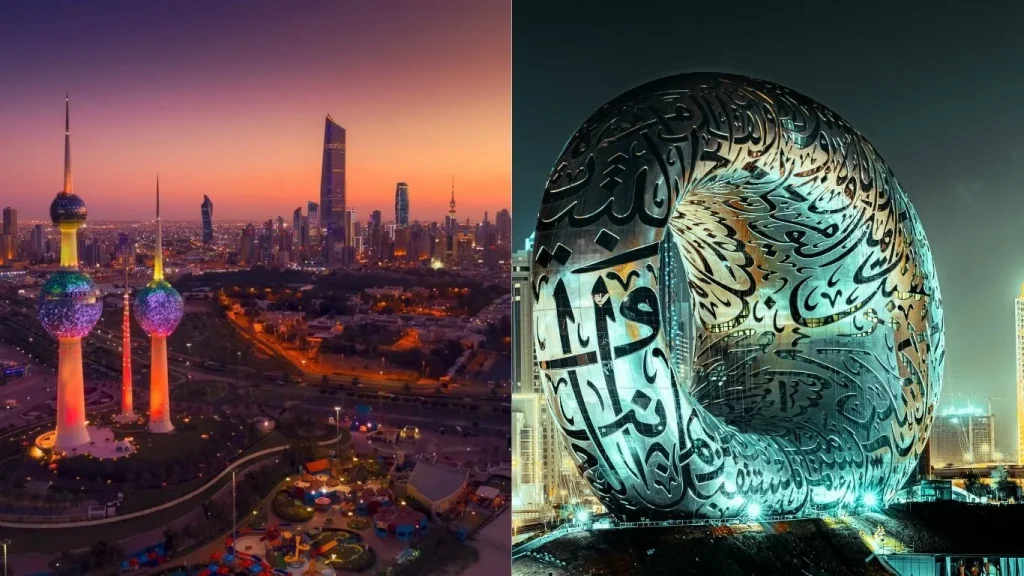
If you are undecided between Kuwait and Dubai (UAE), your choice should be data-driven: from ownership and residency rules to living costs, access to services, and return on investment. The summary table below gives a quick picture of the key differences between the two countries, and then we review each section analytically. We recommend staying with us until the end of this article on Hamed Ghelichkhani‘s website.
| Comparison indicator | Dubai (UAE) | Kuwait |
|---|---|---|
| Individual income tax | None | None |
| Consumption tax | Value Added Tax (VAT): 5% | No Value Added Tax |
| Corporate tax | 9% from 2023 (with incentive policies in some free zones) | 15% on foreign companies and domestic multinational companies |
| Property ownership for foreigners | Free in designated freehold areas (Title Deed) | Very limited; non-Kuwaiti individuals effectively cannot own residential property; recently, non-residential ownership for listed companies with non-Kuwaiti shareholders has been approved |
| Cost of living index (Numbeo 2025) | 58.4 | 42.0–43.0 |
| Rental index (Numbeo 2025) | 51.2 | 22 |
| Monthly net salary (2026 city average) | AED 14,142 (about USD 3,851) | KWD 751 (about USD 2,443) |
| Alcohol consumption conditions | Legal and regulated; apparently since 2023, the 30% municipal tax on alcohol has been removed. | Complete ban on alcoholic beverages |
| Weekend | Saturday – Sunday | Friday – Saturday |
How do culture and lifestyle differ in Kuwait and Dubai?
The cultural atmosphere in both destinations is safe and family-oriented; however, the degree of social freedom and the style of leisure are significantly different. Dubai, United Arab Emirates, as a global hub, offers international events, public beaches, restaurants and diverse entertainment within its legal framework. In contrast, Kuwait is more conservative; the consumption and sale of alcoholic beverages are prohibited and leisure options are more limited compared with Dubai. The working calendar and weekend are also different and affect your daily schedule. In summary:
- In Dubai, the removal of the 30% alcohol levy from January 2023 has reduced the cost of some leisure activities (some sources have referred to the return of this levy).
- Kuwait is considered a traditional country; the import/sale/consumption of alcohol is prohibited.
- The UAE weekend is Saturday – Sunday; Kuwait’s is Friday – Saturday.
- According to reports, urban safety indicators for Dubai are very high (Abu Dhabi and Dubai are among the world’s top 10 cities in terms of urban safety).
Therefore, if you need an international lifestyle, leisure variety and global events, Dubai is the more suitable choice. If you want a more conservative and quieter environment and do not mind leisure restrictions, Kuwait will be acceptable for you.

How much do living costs differ in Kuwait and Dubai?
Kuwait is, on average, cheaper than Dubai in everyday items and rent; however, average net salary is also reported to be lower. Dubai has higher costs, but salary levels and income opportunities are greater in many sectors. For a more precise review of this matter and budgeting, it is better to pay attention to the difference in housing rent, which is your biggest expense; average rent in Dubai is higher than in Kuwait.
- Dubai: cost of living index 58.4, rent index ≈ 51.2, average net salary AED 14,142 or approximately USD 3,851.
- Kuwait: cost of living index 48.1, rent index 28.4, average net salary KWD 751.8 or approximately USD 2,443.
- Individual income tax in both is zero; however, in UAE cities, Value Added Tax (VAT) of 5% is added to most purchases, while Kuwait currently has no VAT.
So if you prioritise “lower costs”, Kuwait is ahead; if “earning potential/project opportunities” matter more to you, Dubai’s additional cost can be offset by higher salaries.
Which one offers more complete welfare services and infrastructure?
Both destinations have efficient healthcare networks and urban infrastructure; however, your access requirements and quality of access are different. Dubai has mandatory health insurance for all residents and offers broad access to hospitals and competitive private insurance. Kuwait provides greater subsidies for Kuwaiti citizens and, from 2023, has been rolling out the DHAMAN health system in phases for insurance and service provision to non-Kuwaiti citizens. Of course, we should bear in mind that the level of coverage and tariffs differ for citizens and non-citizens.
- Dubai: “Dubai Health Insurance Law (Law No. 11 of 2013)” ; insurance coverage is mandatory for all residents.
- Kuwait: The DHAMAN programme is being implemented as an insurance/service-delivery model for expatriates; an annual premium and dedicated hospitals for non-Kuwaiti citizens are envisaged.
- Public safety indicators in the UAE are very high and are also favourable in Kuwait (Kuwait ranked 25th in the world in the GPI 2024; the UAE is outstanding in urban safety).
If “service variety and speed” and a broad private ecosystem for healthcare, international education and smart transport matter to you, choose Dubai; if you are thinking of “citizen subsidies” and a more centralised system, Kuwait will be more acceptable for you.

Where will you have a more profitable investment?
From the perspective of ownership freedom, foreign capital attraction and market liquidity, the UAE/Dubai offers a clearer picture to the foreign investor. At present, Kuwait is reforming this part of its economic structure (KDIPA). But in practice, the entry and exit of capital and the asset options for non-citizens are more limited.
- Company ownership:
- UAE: possibility of 100% foreign ownership on the Mainland (Main Land) for most activities.
- Kuwait: under KDIPA, the possibility of 100% ownership for approved projects.
- Property ownership:
- Dubai: 100% ownership in freehold areas for non-citizens with an official deed from Dubai Land Department (DLD).
- Kuwait: ownership by non-Kuwaiti individuals is effectively prohibited/very limited; in 2026, non-residential ownership was allowed for listed companies with non-Kuwaiti shareholders (not for individuals!).
- Foreign direct investment (FDI):
- The UAE in 2023: USD 30.7 billion inflow; second globally in inflow growth according to UNCTAD.
- Kuwait in 2023: around USD 2.1 billion inflow; improving, but still smaller than regional peers.
- Business tax system:
- UAE: corporate income tax, or CIT, for income above AED 375,000 per year is 9% + VAT of 5%.
- Kuwait: CIT of 15% for foreign legal entities; domestic minimum top-up tax (DMTT) of 15% for large multinational companies (MNE).
Therefore, if you need investment instrument variety (freehold property, startups, free zones), easy capital exit and a deep secondary market, Dubai has clear advantages. If your investment model is project-based, Kuwait can also be a suitable option for you, although the range of instruments available to non-citizens is more limited than in Dubai. But we should bear in mind that the Kuwait Direct Investment Promotion Authority (KDIPA) offers good incentives to investors.
In summary, pay attention to the following:
- Priority of “international lifestyle and networking”: Dubai.
- Priority of “lower housing costs and a conservative environment”: Kuwait.
- Need for “direct property ownership”: Dubai (freehold areas).
- Focus on “industrial/government projects with special incentives”: Kuwait (through KDIPA).
Read more: Is Dubai better or Canada?

Where and how can you buy property?
If your goal is “property investment + residency route”, Dubai has the upper hand. In Dubai, buying freehold property is permitted for non-nationals in designated areas, and for many investors, the official Title Deed is issued by the Dubai Land Department (DLD). According to the latest update to UAE laws, the minimum property value requirement for an investor residency visa has been removed, and with a property purchase of any value, this residency can be obtained and renewed as long as ownership is maintained; for the 10-year Golden Visa, your total property investment must be at least AED 2 million (completed property or off-plan, subject to the stated conditions).
- Ownership scope: Freehold in Dubai’s “freehold areas”; ability to sell, lease, or use the property as bank collateral.
- Property residency thresholds: Any property of any value (2-year residency), AED 2 million (10-year Golden Visa).
- Off-plan projects are also acceptable (for the Golden Visa, subject to project/developer registration and approval, and payment of at least AED 2 million of the total cost and instalments).
One important point for 2-year residency is that if several people plan to buy property together and obtain this type of residency, each person’s share must be at least AED 400,000.
In Kuwait, property ownership for non-Kuwaiti individuals is very limited. In the past, Law 74/1979 prohibited or restricted ownership for non-Kuwaiti nationals. In 2026, Law 7/2025 eased some restrictions for listed companies with non-Kuwaiti shareholders in non-residential properties; however, this change did not open a path for personal home purchases by non-Kuwaiti individuals. So if you are looking for “a freehold residential property in your own name”, Dubai is your practical choice.
How do you register a company, and how free is foreign ownership?
In the UAE/Dubai, after amendments to the Commercial Companies Law, 100% foreign ownership has become possible for most activities in the mainland, in addition to the various options in free zones. This flexibility makes it easier for you to choose a structure, arrange financing and exit capital.
- Mainland: 100% ownership. The list of permitted activities (such as trading, services, manufacturing, and so on) is published in Abu Dhabi/Dubai and is updated regularly.
- Free zones: 100% ownership. Customs incentives (such as various exemptions) and simpler, digital processes, with clear rules relevant to each industry, which may differ across free zones.
- Hiring and work permits: The Ministry of Human Resources and Emiratisation (MOHRE) currently covers 13 types of work permits.
In Kuwait, the main route for foreign investment goes through the Kuwait Direct Investment Promotion Authority (KDIPA): for approved projects, up to 100% ownership, tax exemptions (for up to 10 years) and a “one-stop shop” service are provided to facilitate procedures and permits; however, the “negative list” excludes several strategic sectors from full ownership. Note that the former Shuwaikh free zone was abolished in 2019, and the current model relies on KDIPA’s permit-based framework.
- KDIPA One-Stop Shop: Issuance/follow-up of permits, land allocation and exemptions; profit and capital may be transferred abroad.
- Localisation requirements: For some permits, a Kuwaiti workforce quota is set (especially in incentive-eligible projects).
In short, if you need speed, full ownership, and an international legal/banking ecosystem, Dubai is the better option for you. But if your project is defined within Kuwait’s priority frameworks and KDIPA accepts it, you can obtain meaningful exemptions — provided that you align with the selective permit process.

Which economy and labour market is more dynamic for you?
Growth outlook: The IMF forecast for 2026 shows real GDP growth of around 4% for the UAE and around 1.9% for Kuwait; non-oil diversification is the main driver in the UAE, while Kuwait’s growth remains more dependent on the oil cycle/public investment.
- Non-oil share and drivers: Tourism, construction and financial services are the engines of non-oil growth in the UAE; property demand and foreign direct investment (FDI) inflows are also strong.
- Labour market and regulation: Overall unemployment in both countries is single-digit and low (based on ILO/World Bank reports); the UAE, with the wide range of MOHRE work permits and the flexibility of “simultaneous/part-time work”, offers easier access for you. In 2026, Kuwait made an Exit Permit mandatory for private-sector employees (Article 18), affecting labour mobility.
- FDI and market depth: Foreign capital inflows into the UAE were above USD 30 billion in 2023, and the market has a deeper secondary market/start-up ecosystem; by contrast, Kuwait is improving its FDI inflows, but in terms of volume it is still smaller than Dubai.
If you need labour mobility agility, private/technology projects and a deep secondary market, choose Dubai. If your business model is project-based with government interactions, Kuwait can be your preferred option — but with a realistic project schedule.
Read more: Is Dubai better or Turkey
Which is more cost-effective from a tax perspective?
For individuals in both countries, income tax is zero. For legal entities and consumption, there are important differences you should consider:
- UAE/Dubai:
- Corporate tax on income above AED 375,000 per year will be 9%.
- Income tax (VAT) is also 5%.
- Kuwait:
- Corporate income tax (CIT) is 15% for foreign legal entities; from January 2025, a Domestic Minimum Top-up Tax (DMTT) of 15% is applied to multinational groups.
- VAT has not been implemented up to 2025; several sources have also emphasised that it is not currently in the government’s short-term plan.
So, if your business is a consumer-facing or high-consumption B2C model, the absence of VAT in Kuwait can keep your final cost lower; in contrast, the UAE’s lower CIT rate (9%) is attractive for many structures, especially with planning options in free zones.
Which residency pathways are more achievable “today”?
The UAE/Dubai offers a diverse and renewable range of visa types: the Golden Visa (10 years), 2-year property residency, standard work visa/Green Visa, company incorporation/investor residency and family/student/retirement. Overall, your options for obtaining residency are wider in Dubai.
- Property-based: Any property of any value (2-year residency) and AED 2 million (10-year Golden Visa).
- Employment-based: 12 types of work permits (MOHRE); employment with family sponsorship/part-time work is possible under the new labour law.
- Entrepreneurship/company-based: 100% ownership, investor visa and local emirate options (such as Abu Dhabi’s special conditions for non-property investors).
In Kuwait, residency relies more on sponsorship (kafala):
- Article 18 (private-sector work) is the main route for many non-Kuwaiti nationals; from 1 July 2025, a private-sector employee leaving the country has required employer permission (Exit Permit), which restricts travel and is a negative point.
- Article 22 (family) is for spouses/children; it has income/eligibility conditions, and working usually requires changing the status to Article 18.
- Investor: For approved projects, the issuance of residency for the investor and key employees is предусмотрed (one-stop shop).
Important note: If you want to link “residency directly to your asset/business”, the UAE offers clear options based on investment thresholds. In Kuwait, the residency path for non-nationals is mainly employment-based, while the investment route will be based on project acceptance by KDIPA.
Read more: Dubai and Tehran Comparison
In terms of personal safety, which one is safer?
International indices show both destinations as very safe; with the UAE holding a clear advantage in city rankings.
- Urban safety (Numbeo 2025): Abu Dhabi ranks 1st in the world and Dubai is among the top 10; Kuwait’s capital, Kuwait City, is also considered safe (with a score of 71)
- Global Peace Index 2024 (IEP): Kuwait ranked 25th and the UAE ranked 53rd (lower is better). This index shows a broad governance picture of peace and security and does not necessarily reflect street-level feelings of safety.
In “everyday safety”, UAE cities score higher; in the “broader peace picture”, Kuwait ranks better. Both are among the safest options in the region for families and businesses.
What practical differences do Kuwait’s and Dubai’s climates create for your life and work?
Both climates are very hot deserts; however, the difference between Dubai’s “coastal humidity” and Kuwait’s “dry heat and dust-laden winds” changes your daily routine.
- Averages and highs:
- Dubai (coastal): in summer, average temperatures are between 40 and 45 degrees with high humidity; annual rainfall is low, with occasional severe events (such as the historic 2024 flood).
- Kuwait City (semi-inland): during the summer months, peak highs reach above 40 degrees with lower humidity and seasonal dust; rainfall is very low.
- Comparative climate data (1991 – 2020): the World Bank Climate Portal shows long-term warming and drying trends for both countries.
If humidity bothers you, Kuwait’s dry heat may be easier to tolerate. But if you struggle with dust, Dubai’s humid coast offers a milder experience. For outdoor activities, both require early-morning/evening scheduling in summer and a serious reliance on air conditioning.
What differences do general everyday rules create?
Adherence to “public norms” matters in both countries; however, alcohol consumption, content/media and employee travel create key differences.
- Alcohol
- Dubai: sale/consumption is permitted for non-Muslims; after the suspension of the 30% tax in 2023, from January 2025 distribution companies announced the return of this tax. Licences and the legal age are also in place for consumption.
- Kuwait: a complete ban on imports and production is in place.
- Content and online space
- UAE: Law 34/2021 and the 2025 media law set strict standards and heavy fines for online content/advertising.
- Kuwait: Law 63/2015 criminalises IT offences and imposes restrictions on some areas of online expression.
- Employee travel
- Kuwait: from 1 July 2025, private-sector employees’ departure (Article 18 residency) requires a digital exit permit from the employer. This rule directly affects your travel and leave plans.
For a more liberal lifestyle and a lower risk of employee travel restrictions, Dubai is the more convenient choice. In Kuwait, stricter observance of norms and administrative coordination with the employer are necessary.
Read more: Migration to Dubai
Frequently Asked Questions
Can you freely publish advertising content on social media in both countries?
In general, no; in the UAE, Law 34/2021 and the 2025 media law set standards and fines for content/advertising, and in Kuwait, Law 63/2015 also restricts online activity.
In which country is alcohol consumption possible for you?
In Dubai, it is possible subject to age/licence and the law; in Kuwait, it is prohibited.
Where is urban safety higher for families?
Both countries are safe; however, the rankings of Abu Dhabi/Dubai in urban safety are above the global average, and Kuwait City also has a suitable safety score.
How does the climate difference affect your daily life?
Dubai experiences higher humidity and rare but intense rainstorms; Kuwait has drier heat and more dust. In summer, organise your daily routine with air conditioning and appropriate timing.
If you are a private-sector employee in Kuwait, what should you do for travel?
You must obtain an employer-issued exit permit matching your leave dates (via Sahel/Ashal). Without it, your departure may be refused at the border.
Which country offers a simpler route to “100% ownership”?
In Dubai, a broad range of activities with 100% ownership on the Mainland is permitted; in Kuwait, it is also possible through KDIPA, but on a case-by-case basis and with specific requirements.
What does the Global Peace Index say about Kuwait and Dubai?
In 2024, Kuwait ranks 25th and the UAE ranks 53rd; this index reflects the broader picture of peace/stability and is measured differently from street-level feelings of safety, and the lower the number, the better the situation, meaning Kuwait’s score in this respect is higher than Dubai’s (the UAE).
For content-driven teams or influencer marketing, which destination is lower risk?
Both countries have clear and strict laws; in the UAE, the transparent 2025 media frameworks and the “u.ae” procedures help you assess risks in advance and obtain permits.
